
Pergola Cost Dubai: What Decides the Priceby Dubai Profixer
No honest contractor quotes a pergola sight unseen. This pergola cost Dubai guide breaks down what actually drives the price — material, size, roof cover, design, furnishing and site conditions — and how to get an accurate quote.
On this page
- Why Pergola Quotes Vary So Much
- Factor 1: Material — Wood vs Aluminium
- Factor 2: Size & Dimensions
- Factor 3: Roof Covering
- Factor 4: Design Complexity
- Factor 5: Furnishing
- Factor 6: Site Conditions
- Factor 7: Finishes & Extras
- Pergola Cost vs Long-Term Value
- Why Two Quotes Differ
- How to Get an Accurate Quote
- FAQs
"How much does a pergola cost in Dubai?" is the first question almost every homeowner asks — and it's the one question no honest company answers with a single number. A pergola isn't a product with a price tag; it's a small building, and its cost depends on what's being built, from what, how big, and on what ground. This guide explains every factor that decides pergola cost in Dubai so you can understand quotes, compare them fairly, and know exactly what information gets you an accurate price.
Why Pergola Quotes Vary So Much
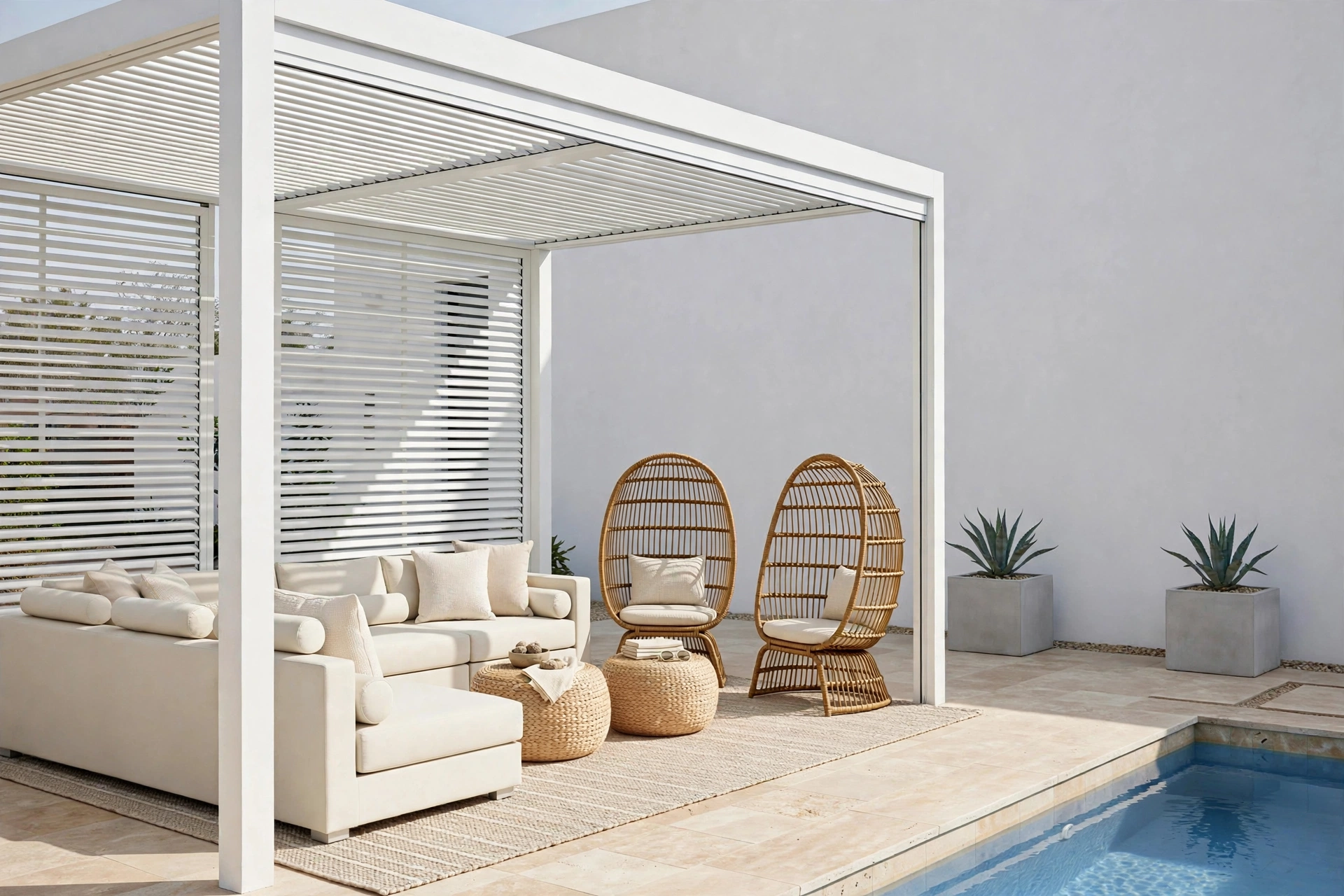
Ask three companies for a pergola quote and you may get three very different numbers — not because anyone is being dishonest, but because "a pergola" can mean radically different things, and that is exactly why pergola cost Dubai searches return such a wide range. A compact open-rafter aluminium pergola over a townhouse terrace and a large covered hardwood pergola with lattice screens, lighting and full outdoor furniture are both "pergolas," but they share almost nothing in materials, labour or engineering.
The factors below stack. A small, simple, open structure on easy ground sits at one end of the range; a large, covered, furnished, custom-detailed structure on difficult ground sits at the other — and most real projects land somewhere between. Understanding the factors is what lets you read a quote intelligently instead of just comparing bottom lines.
Factor 1: Material — Wood vs Aluminium
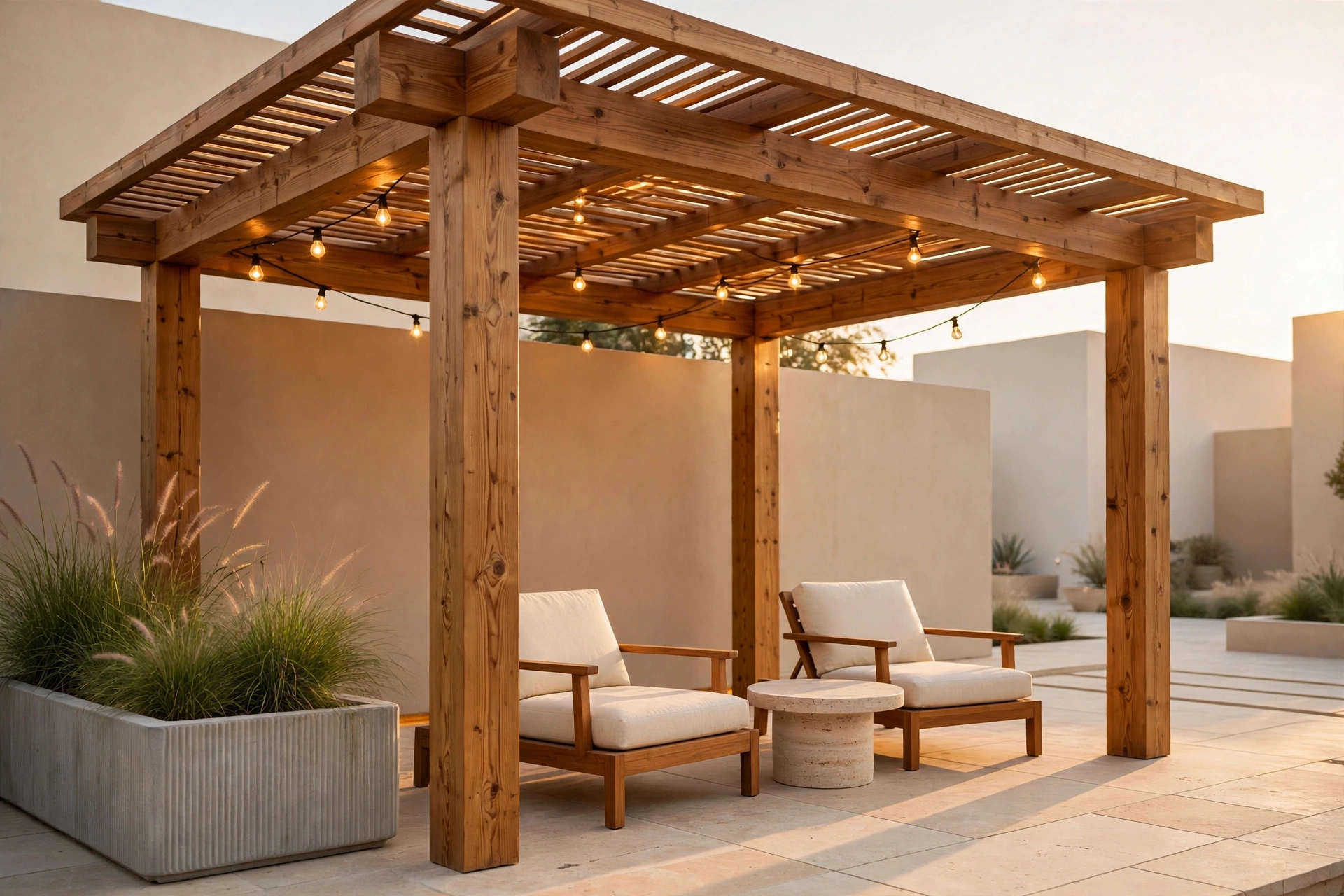
Material is usually the single biggest cost driver. Timber pergolas vary enormously by species: readily available treated softwoods sit at the accessible end, while dense hardwoods with natural weather resistance cost substantially more — but bring richer colour, finer grain and longer service life. The grade, section sizes and finish quality all move the number within each species.
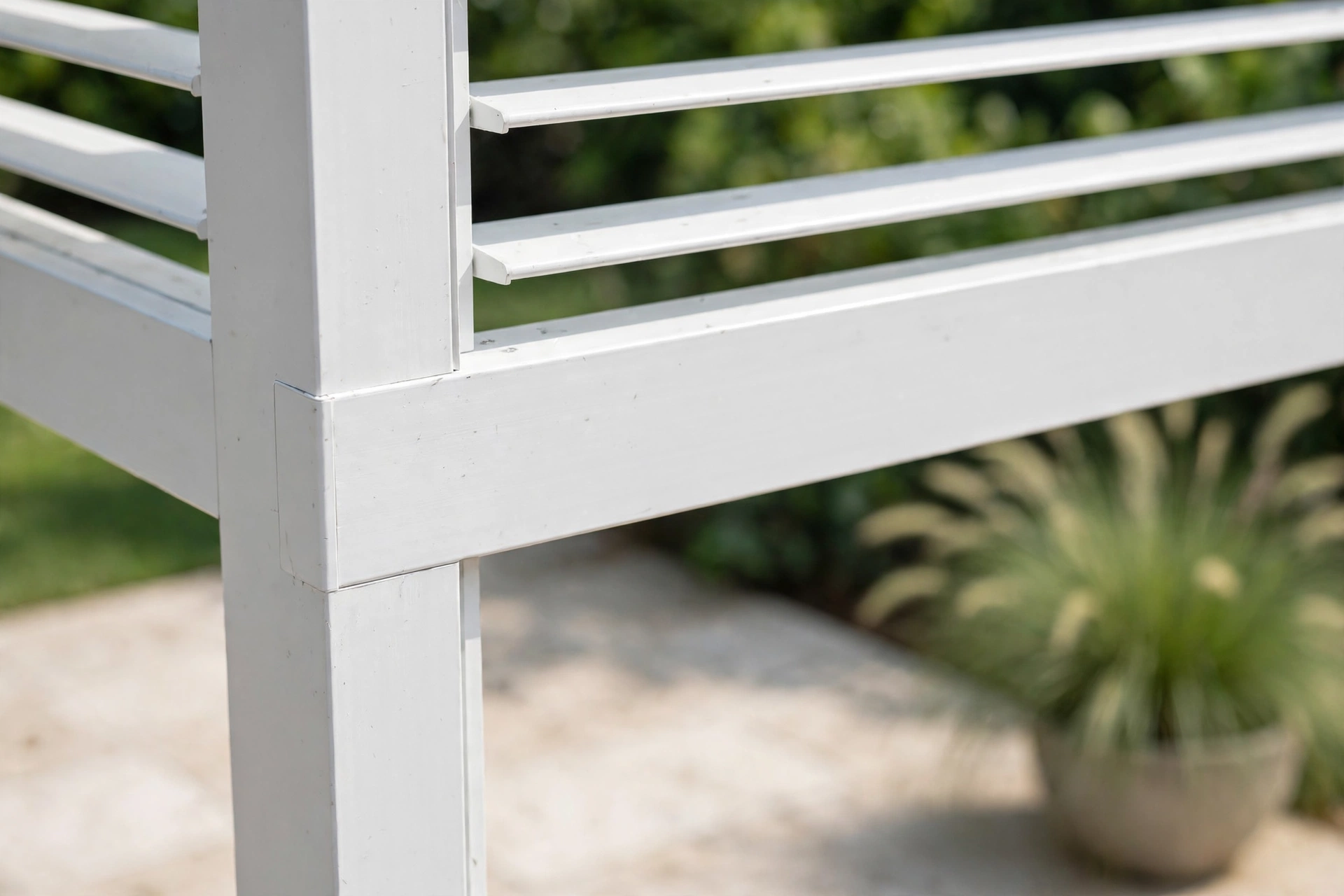
Aluminium pergolas price differently. The material itself is consistent — powder-coated structural aluminium — so cost differences come mainly from the profile sizes, the engineering of the connections, and the quality of the powder-coating and fixings. Aluminium doesn't have timber's species ladder, which makes its pricing more predictable from project to project.
Comparing the two honestly: a basic timber pergola can cost less than an aluminium one, while a premium hardwood pergola can cost more. The crossover point depends on the species, the sizes and the design. Don't assume one material is always cheaper — ask for both options quoted on the same design and compare like with like. Our wooden pergola and aluminium pergola pages explain each material's characteristics in full.
- Timber species: the widest cost range — softwood to premium hardwood spans the market.
- Section sizes: chunkier beams and posts use more material and cost more in both wood and aluminium.
- Finish quality: proper treatment, staining or powder-coating adds cost but protects the investment.
- Fixings: stainless or concealed fixings cost more than basic hardware and last far longer.
Factor 2: Size & Dimensions
Size drives cost in two ways: material quantity and structural demand. A larger pergola needs more posts, beams and rafters — but it also needs bigger sections and deeper footings, because spans and wind loads grow with size. Doubling the footprint more than doubles the engineering.
Height matters too. Taller pergolas need longer posts, more bracing and more careful wind engineering — Dubai's gusts are real, and a tall, large pergola is effectively a sail. Anything above a modest garden structure should be properly engineered for wind loads, and that engineering is part of the cost.
When measuring for a quote, give the full footprint you want covered — not just the furniture zone. The pergola should extend generously beyond the furniture, and that overhang is part of the size you're pricing.
Factor 3: Roof Covering
An open-rafter roof — beams and rafters with sky between them — is the simplest and most economical roof. Adding a fixed cover above the rafters changes the cost picture meaningfully: there's the cover material itself, the additional structure to carry it, and the detailing where it meets the beams and drains.
The value question is about use: a covered pergola gives genuine shelter and a noticeably cooler space beneath, which extends the hours and months you'll actually use it. For a dining area you plan to use daily, the cover often pays for itself in use. For a decorative garden feature or a sun-lounger spot, open rafters may be all you need.
Partial cover is the cost-smart compromise: cover the seating and dining bays where you need real shade, leave rafters open over planting or circulation. You get the shelter where it counts without paying to roof the whole structure.
Factor 4: Design Complexity
A rectangular pergola with standard joints is straightforward to build. Every deviation from the rectangle adds labour: angled or curved layouts, lattice screens, arched openings, shaped beam ends, integrated planters, multi-level roofs. None of these are expensive in materials — they're expensive in skilled hours.
This is where design taste meets budget most directly. A simple, beautifully proportioned pergola in good materials often looks better — and costs less — than a complicated design in cheap materials. If budget is tight, spend it on material quality and clean execution rather than decorative complexity. Good proportions are free; bad ones can't be fixed with ornament.
- Simple rectangle: the most economical form — standard cuts, standard joints.
- Lattice and screens: add real cost in labour; worth it for shade and privacy.
- Curves and angles: beautiful but labour-intensive — budget accordingly.
- Integrated features: planters, benches and storage add joinery hours.
Factor 5: Furnishing
Many pergola quotes cover the structure only — and clients are surprised when the beautiful renders they admired turn out to include furniture, lighting and decor that weren't in the price. If you want a furnished pergola — the complete outdoor room with seating, dining and lighting — the furnishing is a real part of the project cost and should be quoted as one.
Outdoor furniture in Dubai needs to handle intense sun and heat: quality outdoor fabrics, powder-coated or teak frames, and cushions that survive the climate. This is not the place for indoor furniture dragged outside — it will fail within a season. Budget the furniture as part of the project from the start rather than as an afterthought; a stunning pergola with collapsing chairs underneath it is a wasted structure.
Our furnished pergolas are designed as complete outdoor rooms — structure, seating, dining and lighting planned together, so the proportions, clearances and cable routes all work from day one.
Factor 6: Site Conditions
Two identical pergolas on two different plots can cost different amounts to install, because the site is part of the job. The factors that matter:
- Ground conditions: posts need proper footings. Soft soil, sand, existing paving that must be cut and reinstated, or services buried where footings need to go — all add work.
- Access: can materials and equipment reach the garden easily? Villas with side access are straightforward; gardens reachable only through the house need careful handling and protection.
- Existing structures: wall-mounted pergolas need a sound wall to fix to; remedial work on a damaged facade adds cost.
- Levels and drainage: sloped gardens need stepped footings and thought about where water runs; flat plots are simpler.
- Nearby planting and features: protecting existing landscaping, working around pools or built-in BBQ areas takes care and time.
This is why a site visit or detailed photos matter so much for accurate quoting — and why phone quotes given without seeing the site should be treated as rough estimates, not commitments.
Factor 7: Finishes & Extras
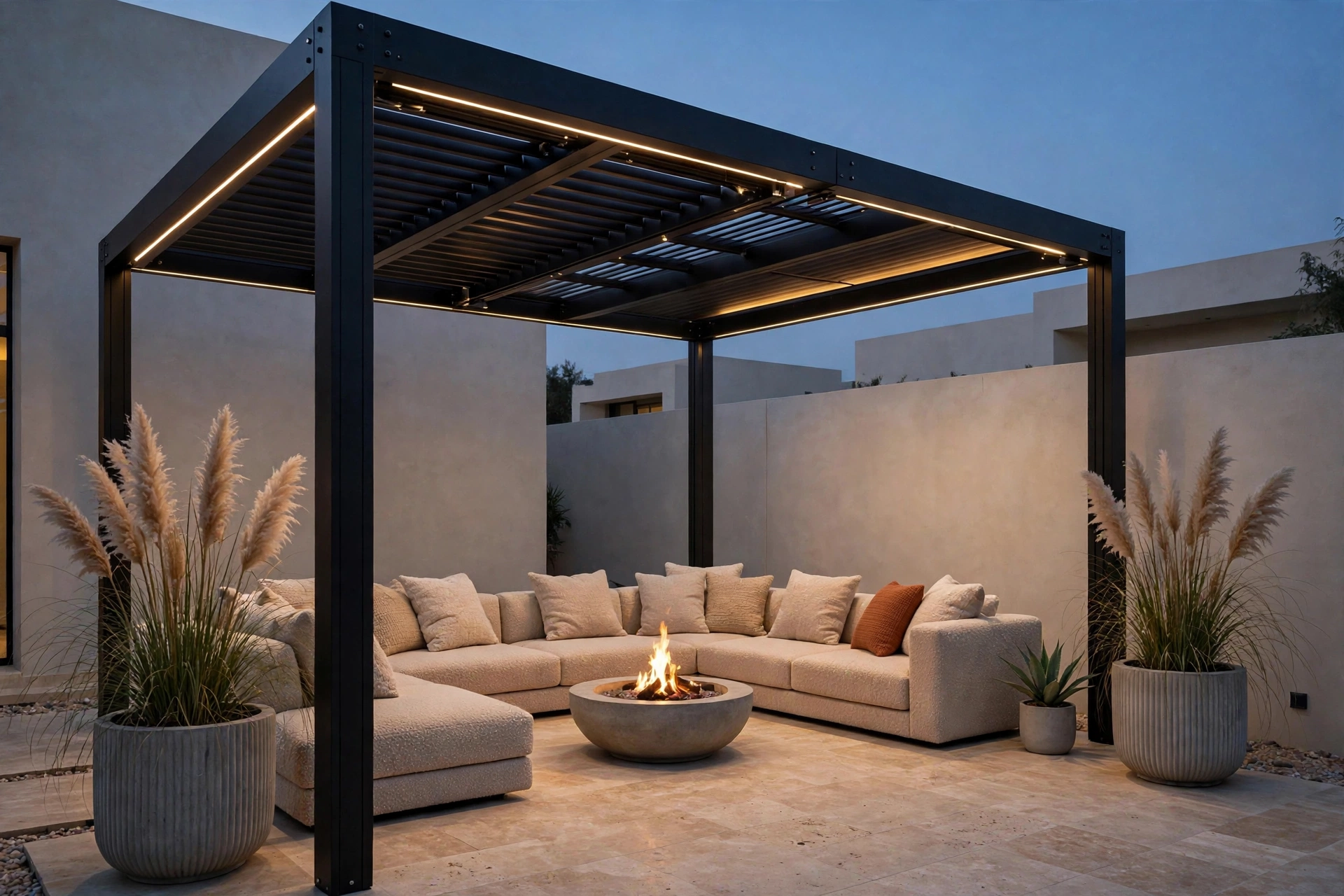
The final layer of cost is everything that turns a structure into a finished outdoor room. Lighting is the biggest item here — recessed LED strips, spotlights, pendants and their cabling, planned during the build. Electrical work must be done properly and safely; it's skilled labour, not an accessory.
Other finish items: staining or oiling timber (and the ongoing maintenance it implies), decorative screens, integrated planters, outdoor curtains or shade sails for extra sun control. Each is modest alone; together they complete the space. Decide which extras matter to you before quoting, so every company prices the same scope.
Pergola Cost vs Long-Term Value
It's tempting to judge a pergola purely on its installation quote. But a pergola is a long-term structure, and the cheapest quote today isn't always the cheapest outcome over the years. Thinking in terms of lifetime value changes the comparison.
Maintenance is a real cost. A timber pergola's purchase price is only the first payment — re-finishing every few years costs materials and labour each time, and the bill arrives whether you feel like paying it or not. When comparing a timber quote against an aluminium one, add a realistic maintenance allowance to the timber side across the years you plan to stay in the villa. Sometimes timber still wins on character and the maths still favours it; sometimes the gap closes entirely. Do the sums honestly rather than hoping maintenance won't be needed.
Longevity protects the investment. A well-built pergola in quality materials, properly installed with sound footings, serves for many years. A cheap structure in poor materials can need major repairs or early replacement — and replacing a pergola costs more than building it right once, because you're paying for demolition and disposal too. This is the strongest argument for spending on material quality and proper installation rather than decorative extras: structure first, ornament second.
Use is the real return. The value of a pergola isn't abstract — it's measured in evenings spent outside, meals under shade, and a garden that becomes part of the home rather than scenery. A covered, furnished pergola used daily through most of the year delivers far more value than a bare open structure admired from the window, even if the covered one cost more. When budgeting, weigh how often each design will actually be used. In Dubai's villa market, generous, well-designed outdoor living space is genuinely prized — design for use, not just for photographs.
Furniture has its own lifecycle. Outdoor furniture in Dubai's sun wears faster than the structure above it. Budget for quality outdoor-grade pieces from the start, and accept that cushions and fabrics are consumables over the years while frames endure. Buying the cheapest furniture to "save" money usually means buying twice.
Why Two Quotes for the "Same" Pergola Differ
When quotes differ wildly, it's almost always a scope difference hiding behind the same word "pergola." Before choosing the cheapest quote, check what's actually included:
- Material specification: which timber species, or what grade of aluminium and coating? "Wooden pergola" can mean very different things.
- Footings and groundwork: included, or left for you to arrange?
- Roof cover: open rafters or covered — and if covered, with what?
- Lighting and electrics: included with cabling, or structure only?
- Furniture: structure only, or the furnished outdoor room?
- Finishes: stain, oil or powder-coat included, or raw structure?
- Aftercare advice: will they explain maintenance, or disappear after installation?
A detailed quote that lists every element is worth more than a cheap lump sum. If a quote seems too good to be true, ask which of the items above were left out — the answer is usually illuminating.
How to Get an Accurate Quote
The fastest route to a meaningful number is to give the contractor what they'd see on a site visit:
- Garden dimensions: the length and width of the area, and the footprint you'd like covered.
- Photos: wide shots of the space from several angles, plus the wall if you're considering a wall-mounted design.
- What goes underneath: dining for how many, lounge seating, majlis, or a mix — this sets the size.
- Material preference: wood, aluminium, or you'd like both quoted for comparison.
- Roof preference: open rafters, covered, or partially covered.
- Extras: lighting, furnishing, screens — everything you want included.
Send all of this on WhatsApp and you'll get a quote built from your actual project — not a guess. We work 7:00 AM–12:00 midnight, seven days.
Pergola Cost: FAQs
Want a Price for Your Pergola?
Send us your garden dimensions, a few photos, and what you'd like underneath — dining, lounging, or both. We'll price your actual project.
Request a Quote