
Types of EV Chargers — Which One Should You Buy
BY DUBAI PROFIXER
Shopping for an EV charger in Dubai? Compare the types of ev chargers — wallboxes, connectors, smart features — before you spend a dirham. You buy the unit. Dubai Profixer installs it, safely wired and tested.
Dubai Profixer recommends from real Dubai installs — most villa buyers choose a 7.4 kW single-phase wallbox, while larger villas with three-phase supply suit 11 or 22 kW units. Portable Level 1 cables are a backup option, and DC fast chargers belong in public stations.
Every EV sold in the UAE uses the Type 2 connector for AC charging, so one wallbox suits almost every brand — Tesla, BMW, Hyundai and more.
Buy the unit that matches your supply and parking, then call 0524601612 — Dubai Profixer surveys your site and installs it, tested and ready, from 7 AM to 12 midnight daily.
Read this first
How to Use This Guide — You Buy, We Install
At Dubai Profixer, we are installation specialists, not a charger shop. That means this guide has no product to push — just honest buyer advice so you purchase the right unit once, instead of the wrong one twice.
Every charger type below is one Dubai Profixer installs regularly across Dubai. Read the sections that match your situation, shortlist a unit, then message the model to 0524601612. We confirm it suits your property during the survey.
The full lineup
Types of EV Chargers Compared — All Six Categories
Six charger categories cover everything on the Dubai market. Most buyers only need to compare the first three — the rest matter for offices, fleets and stations.
Read each card, match it to your property’s electrical supply, and shortlist before you buy. Every unit here is one we install.
Backup only
🔌 Level 1 — Portable Granny Cable
The portable cable that comes with your EV plugs into any standard 13A wall socket. No installation, no electrician, no cost.
It is also the lowest-power way to charge, so keep it as a travel backup — not your daily solution. Continuous heavy draw can stress older household wiring, which is why a dedicated wallbox exists.
- Zero installation — plugs into any socket
- Handy as a travel and emergency backup
- Not a substitute for a proper wallbox
- Best paired with a Level 2 home charger
Best for villas
🏠 Level 2 — 7.4 kW Home Wallbox
The standard choice for villa garages and driveways across Dubai. A 7.4 kW wallbox runs on a 32A single-phase dedicated circuit — the supply most villas already have. For home EV charger installation in Dubai, the 7.4 kW wallbox below is the usual pick.
The unit mounts on the wall, gets its own breaker, and delivers steady AC power through a Type 2 connector. This is the charger we install most, and the one most buyers should start with.
- Runs on standard single-phase supply
- Dedicated circuit with RCBO protection
- Neat wall mount with cable holster
- Smart app control on most models
Needs 3-phase supply
⚡ 11 kW Three-Phase Wallbox
An 11 kW wallbox draws power across three phases, which suits properties with a three-phase DEWA supply — some larger villas and shared residential parking.
Before buying one, confirm your property actually has three-phase power. A single-phase villa cannot feed this unit no matter how good the deal looks. We verify your supply during the survey.
- Higher power for three-phase properties
- Check your supply type before buying
- Suits three-phase villas
- Needs matching three-phase cabling
High-power homes & offices
⚡ 22 kW Three-Phase Wallbox
The most powerful AC wallbox you can buy. Like the 11 kW unit, it needs three-phase supply — plus a switchboard with enough spare capacity to feed it.
It suits homes running two electric cars on one charger. For a single EV in a standard villa, it is usually more charger than you need.
- Top AC power for demanding sites
- Three-phase supply is mandatory
- Great for dual-EV households
- Heavier cabling and breaker requirements
Public stations
🏢 DC Fast Chargers — 50 kW and Up
DC fast chargers bypass the car’s onboard charger and feed the battery directly, at 50 kW to 150 kW and beyond. They are built for malls, fleet depots, petrol stations and highway stops.
These units need industrial three-phase supply, civil works, and serious budget. If a seller offers you one for a villa garage, walk away — this is not home equipment.
- Built for fleets, malls and stations
- Industrial supply and civil works needed
- Not suitable for home garages
- Not installed at homes — public sites only
Notice a pattern? The first four are the same idea at different power levels — AC wallboxes for private parking. The DC fast charger belongs to public stations.
That simplifies your decision enormously. For a Dubai villa, the real choice is usually between the 7.4 kW wallbox and the 11 or 22 kW units — and your supply type decides that for you.
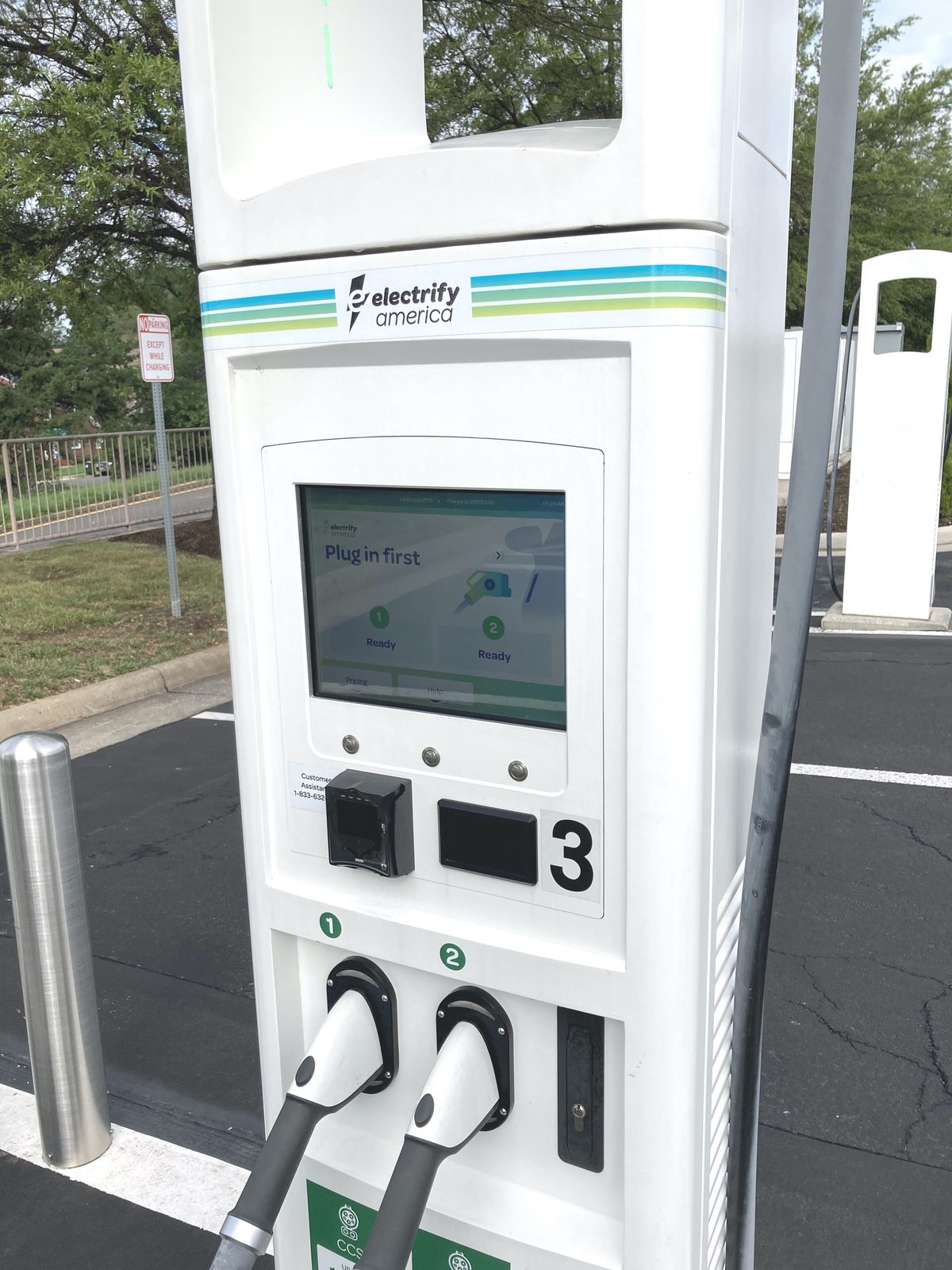
DC fast charging stations like these belong in public sites — malls, fleet depots and highway stops — not villa garages.
Wall-mounted or carry it
Fixed vs Portable EV Chargers — Which Setup Suits You
A fixed wallbox lives permanently on your garage wall, wired to its own circuit. A portable charger travels with the car and plugs into whatever socket is available.
Most Dubai EV owners end up with both — a fixed wallbox for daily use and a portable cable in the boot for emergencies.
🏠 Fixed Wallbox — The Daily Driver Setup
A fixed wallbox is mounted on the wall, hardwired to a dedicated circuit with its own RCBO breaker and surge protection. It stays dry, stays secure, and is always ready.
Because it sits on its own circuit, it runs at its full rated power every session. The cable holster keeps everything tidy, and most units add app control, scheduling and energy monitoring.
Installation is a one-time job — survey, mount, wire, test. After that you simply plug in. This is the setup we install for villas, and the one we recommend for anyone with a private parking spot.
🎒 Portable Charger — The Backup Plan
A portable charger is the granny cable supplied with your EV, or a higher-rated portable unit you buy separately. It plugs into a standard socket wherever you are.
The tradeoff is power and safety. Household sockets were not designed for hours of continuous high draw, and older wiring can overheat. Portable charging should stay occasional — a backup, not a habit.
Still, every EV owner should carry one. It has saved many drivers at relatives’ houses and older buildings with no wallbox. Buy the wallbox for home; keep the cable in the boot for everywhere else.
Bottom line — a portable cable is something your car probably already includes. The buying decision that matters is the fixed wallbox.
The cable question
Tethered vs Untethered Chargers — Pick Your Cable Style
Once you have chosen a wallbox, one more choice waits — does the cable come fixed to the unit, or do you bring your own? This is the tethered versus untethered decision.
There is no wrong answer, but the wrong choice for your parking layout means daily annoyance. Here is how buyers in Dubai usually decide.
🔗 Tethered — Cable Fixed to the Unit
A tethered wallbox has its charging cable permanently attached, coiled on a holster beside the unit. Arrive home, grab the plug, connect — done. Nothing to fetch from the boot, nothing to store wet after rain.
This is the convenience pick, and it suits villa garages where the charger is yours alone. The cable length is fixed — typically 5 metres — so check it reaches your car’s charge port from the mounting spot.
The small tradeoff is future flexibility. The connector is built in, so if plug standards ever change, the whole unit ages with them. For the UAE’s stable Type 2 standard, that is a minor concern.
🔌 Untethered — Bring Your Own Cable
An untethered wallbox has no built-in cable — just a neat Type 2 socket on the unit. You carry your charging cable in the car and plug it in at both ends when you arrive.
The look is cleaner: no coiled cable on the wall, nothing dangling in the garage. And if a cable wears out or standards shift, you replace a cable — not the charger.
The daily cost is convenience. You handle the cable twice per session and store it somewhere dry afterwards. For shared parking or offices where tidiness matters, that tradeoff is worth it.
Our take — tethered for private villa garages where you charge daily, untethered for shared bays, offices and anyone who values a clean wall over grab-and-go speed.
Beyond basic charging
Smart EV Charger Features — Worth Paying For
A basic wallbox delivers power. A smart wallbox delivers power on your terms — scheduled, monitored and balanced against your home’s other loads.
Smart models cost more upfront, but in Dubai the features below pay back in convenience and electrical safety. Here is what each one actually does.
📱 App Control & Scheduling
Start and stop charging from your phone, and schedule sessions for off-peak tariff hours. You set the rules once — the charger follows them automatically.
Scheduling is the single most-used smart feature in Dubai homes. It is also how offices restrict charging to staff hours.
⚖️ Load Balancing
Load balancing watches your home’s total electrical demand and throttles the charger so the main breaker never trips.
It matters most in villas running heavy air conditioning and pool equipment alongside the charger — and it is essential when two chargers share one supply.
📊 Energy Monitoring
Smart chargers log every kilowatt-hour they deliver. You see exactly what your EV costs to run each month — useful for expense claims and for settling costs between two drivers.
Offices use the same data to bill departments or tenants per bay.
☀️ Solar Integration
Some smart chargers talk to home solar systems and prioritise surplus solar power for the car. With Dubai’s sunshine, villa owners with rooftop panels get real value here.
If you have solar now — or plan it — buy a charger that already speaks its language.
🔐 RFID & Access Control
RFID cards or app-based access restrict who can start a charge. It is standard kit for offices, towers and retail sites where chargers sit in shared parking.
Home users rarely need it — your garage door is the access control.
🔄 Firmware Updates
Smart chargers update over Wi-Fi, gaining new features and tariff profiles without a service visit. A basic unit never improves after installation day.
If you keep cars for years, this extends your charger’s useful life.
Our recommendation — for a Dubai villa, buy a smart 7.4 kW wallbox with app scheduling and load balancing. The price gap over a basic unit is small, and these two features solve the problems villas actually have.
Plugs, demystified
EV Connector Types — What Fits Your Car
Connector confusion stops many buyers cold. The good news — in the UAE, the answer is simple. The country follows the European standard, and nearly every EV sold here speaks the same plug language.
Still, it pays to know the names, because you will see them on every charger listing.
UAE home standard
🔌 Type 2 — Mennekes
The seven-pin plug used for AC charging across Europe and the UAE. This is the connector on virtually every home wallbox sold in Dubai.
If you buy one thing from this guide, buy a Type 2 wallbox. Tesla, BMW, Hyundai, Kia, Audi, Mercedes — they all charge on it at home.
- Standard for all UAE home wallboxes
- Handles single and three-phase AC
- Fits nearly every EV sold in Dubai
- Check your manual to confirm yours
DC fast charging
⚡ CCS2 — Combined Charging System
CCS2 adds two large DC pins below the Type 2 shape, creating the plug used at DC fast charging stations. Your car’s charge port accepts both.
You will never install a CCS2 connector at home — it lives at public DC fast charging stations. But knowing the name helps you read your car’s spec sheet correctly.
- Used at DC fast charging stations
- Combines Type 2 AC with DC pins
- Standard on new EVs in the UAE
- Not a home installation item
Legacy note
🕰️ CHAdeMO — Older Imports
CHAdeMO is the Japanese DC fast charging standard, found on some early-generation EVs and grey imports — early Nissan Leaf models, for example.
It does not affect your home wallbox choice: AC home charging on these cars still runs through Type 2. It only matters at public DC stations, where you check plug availability before you go.
- Found on some early Japanese EVs
- DC fast charging only, not home AC
- Does not change your wallbox choice
- Check before relying on public stations
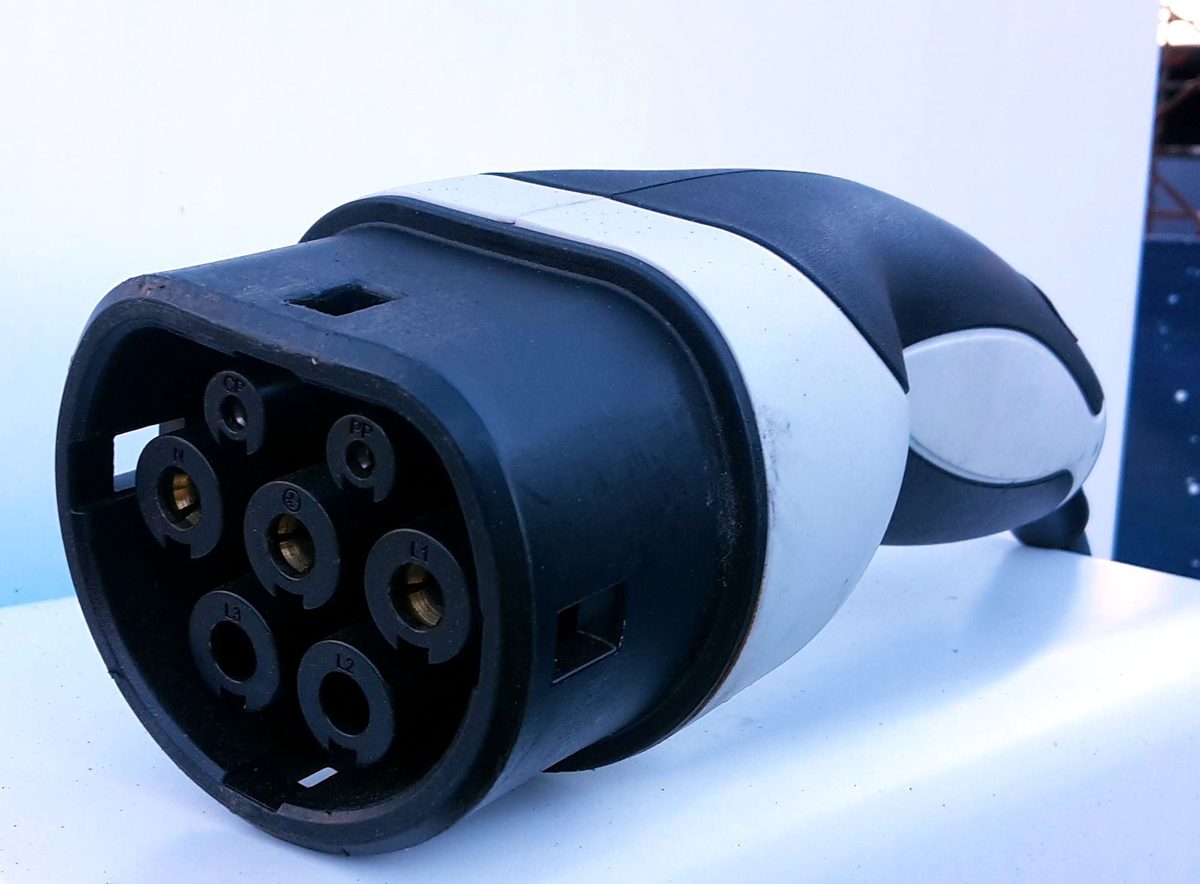
A Type 2 (Mennekes) plug close-up — the seven-pin connector your home wallbox will use. If your EV was bought new in the UAE, this is almost certainly your plug.
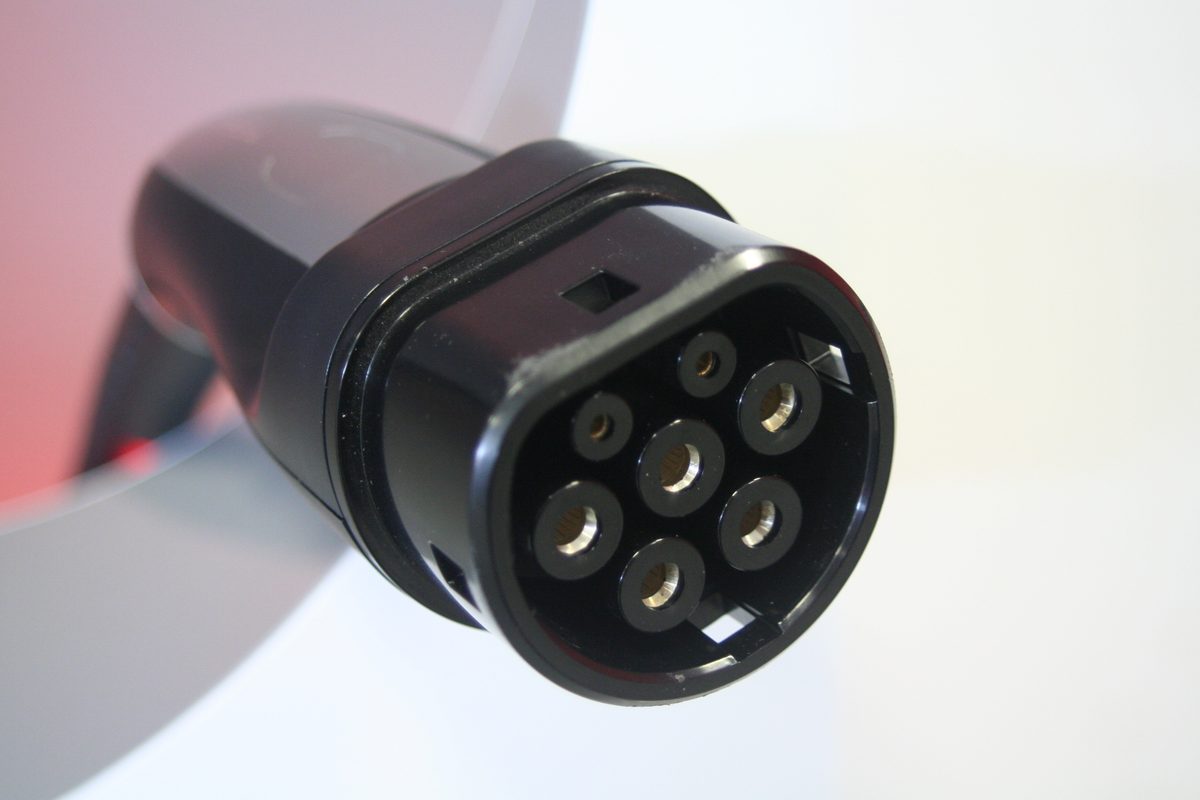
A DC fast charging connector close-up. These larger plugs live at public charging stations — your home wallbox uses the smaller Type 2 AC plug shown above.
Dubai-proof your install
Outdoor EV Charger Ratings — Surviving Dust and Sun
Many Dubai wallboxes live outdoors — on driveway walls, in open parking bays, under carports. The unit must handle dust storms, summer heat and the occasional downpour.
That is what the IP rating tells you. Read it before you buy, because an indoor-rated charger on an exposed wall is a problem waiting for summer.
IP54 — The outdoor minimum
The 5 means dust-protected, the 4 means splash-proof from any direction. This is the minimum rating we recommend for any charger mounted outside. Most quality wallboxes carry it as standard.
IP65 — Better dust defence
The 6 means fully dust-tight, the 5 means protected against water jets. In Dubai’s dusty months, IP65 gives extra confidence for fully exposed driveway or rooftop installations.
UV and heat resistance
Dubai sun degrades cheap plastics and fades displays. Look for UV-stabilised enclosures on outdoor units, and mount in shade where possible — under a carport beats a bare south-facing wall.
Cable and mounting protection
Outdoor installs need armoured cabling in UV-rated containment, plus a holster or dock that keeps the plug off the ground. We also recommend a small canopy or bollard where cars manoeuvre close to the unit.
Garage installs skip the worry
A wallbox inside a closed garage needs no outdoor rating at all — IP ratings only matter where rain, dust and direct sun reach the unit. Indoor mounting also keeps cable runs short and neat.
What we check on survey
During the site survey we note your exact mounting location, sun exposure and dust levels, then confirm your chosen unit’s rating suits the spot. If it doesn’t, we tell you before installation day — not during it.
One car or two
Single vs Dual-Socket Chargers — Planning for Two EVs
Many Dubai households now run two electric cars — or plan to. The question is whether to buy one charger per car, or one dual-socket unit that serves both.
The answer depends on your parking layout and your electrical supply. Here is how the two approaches compare.
🔌 Single-Socket Wallbox
One unit, one cable, one car at a time. This is the standard home setup and suits households with a single EV — or two EVs where the cars simply take turns.
The advantage is simplicity. One dedicated circuit, one breaker, one mounting point, lower equipment cost. Most 7.4 kW smart wallboxes are single-socket, and they cover the most common case.
If a second EV arrives later, a smart single-socket unit with load balancing can often be paired with a second charger on the same supply. Future-proofing starts with buying smart today.
🔌🔌 Dual-Socket Wallbox
One unit with two charging outlets, serving two cars from a single mounting point. The unit splits its available power between the two sockets — either evenly or by priority.
This suits side-by-side parking where two EVs charge side by side. It needs only one mounting point and one cable route, which simplifies installation in tight garages.
The electrical demand is higher, so your switchboard must support the combined load. Tell us you run two EVs when you message 0524601612 — we size the circuit and breakers correctly from the start.
Our guidance — one EV today, maybe two later? Buy a smart single-socket 7.4 kW wallbox now. Two EVs already on the driveway? Talk to us about dual-socket or paired units with load balancing.
Match it to your property
Which Charger for Your Property — Villa or Apartment
The best charger is the one that matches your supply, your parking and your daily routine. Find your situation below and start your shortlist there.
Most common case
🏡 Villa with Private Garage
The ideal setup. A 7.4 kW single-phase smart wallbox on your own dedicated circuit, mounted inside the garage or on the driveway wall.
Choose tethered for daily convenience, smart features for scheduling and load balancing, and IP54 or better if the unit sits outdoors. The cable run to the switchboard is usually short, which keeps installation neat.
- 7.4 kW smart wallbox, Type 2
- Tethered cable for grab-and-go use
- App scheduling and load balancing
- We install in one working visit
Needs building approval
🏢 Apartment with Allocated Bay
Apartment charging is absolutely possible — it just starts with paperwork. Your building management or landlord must approve the charger location and the cable route through common areas first.
Technically, the setup mirrors a villa: a 7.4 kW smart wallbox on a dedicated circuit, usually fed from your DEWA meter. Untethered units suit shared basements where a tidy wall matters.
- Written approval comes first
- 7.4 kW smart wallbox, Type 2
- Untethered keeps shared bays tidy
- We prepare drawings for management
Growing families
👨👩👧 Two-EV Household
Two electric cars under one roof need a plan, not just a second wallbox. A load-balancing setup lets both chargers share your villa’s supply without tripping the main breaker.
We design dual-charger homes as one package — survey, wiring and commissioning for both bays in a single project.
- Load balancing shares one supply
- One survey covers both bays
- 7.4 kW units suit most dual setups
- Call Dubai Profixer on 0524601612 to plan yours
Still torn between two options? Send both models to 0524601612 on WhatsApp with a photo of your parking spot. We tell you which one your property actually supports — and why.
One charger fits almost all
Car Brand Compatibility — Will It Fit Your EV
The UAE follows the European charging standard — Type 2 for AC home charging and CCS2 for DC fast charging. That means one properly chosen wallbox works with virtually every EV sold in the country.
Below are the brands our installations commonly cover. If your EV is not listed, message us — if it charges on Type 2, we can install for it.
Tesla
Model 3, Model Y, Model S, Model X — Type 2 AC in the UAE.
BMW
iX, i4, i7 — Type 2 AC, CCS2 for DC.
Mercedes-Benz
EQS, EQE, EQA, EQB — Type 2 AC, CCS2 for DC.
Audi
e-tron, Q4 e-tron, Q8 e-tron — Type 2 AC.
Porsche
Taycan, Macan Electric — Type 2 AC, CCS2 for DC.
Hyundai
Ioniq 5, Ioniq 6, Kona Electric — Type 2 AC.
Kia
EV6, EV9, Niro EV — Type 2 AC, CCS2 for DC.
Nissan
Ariya, newer Leaf — Type 2 AC. Early Leaf imports may differ.
Volkswagen
ID.4, ID.Buzz — Type 2 AC, CCS2 for DC.
BYD
Atto 3, Seal, Dolphin — Type 2 AC, CCS2 for DC.
Volvo & Polestar
XC40 Recharge, C40, Polestar 2 — Type 2 AC.
Lucid
Lucid Air — Type 2 AC, CCS2 for DC.
Buyer questions answered
Types of EV Chargers — FAQs
Bought Your Charger? We Install It
Now you know the types of ev chargers — buy the right unit, then hand the hard part to us. Surveyed, safely wired and fully tested, from 7 AM to 12 midnight daily. Want the full overview? Start at our main EV charger installation in Dubai page.