
Solar Water Heater Installation in Dubai
Planning a solar hot water system for a villa or managed property? Dubai Pro Fixer lists solar water heater installation among its Dubai property services. We can discuss your property, existing hot water arrangement and the information needed for a site assessment and quotation. Call 052 460 1612, message us on WhatsApp, or use our contact page. A suitable system and installation scope depend on the property, demand and onsite findings.
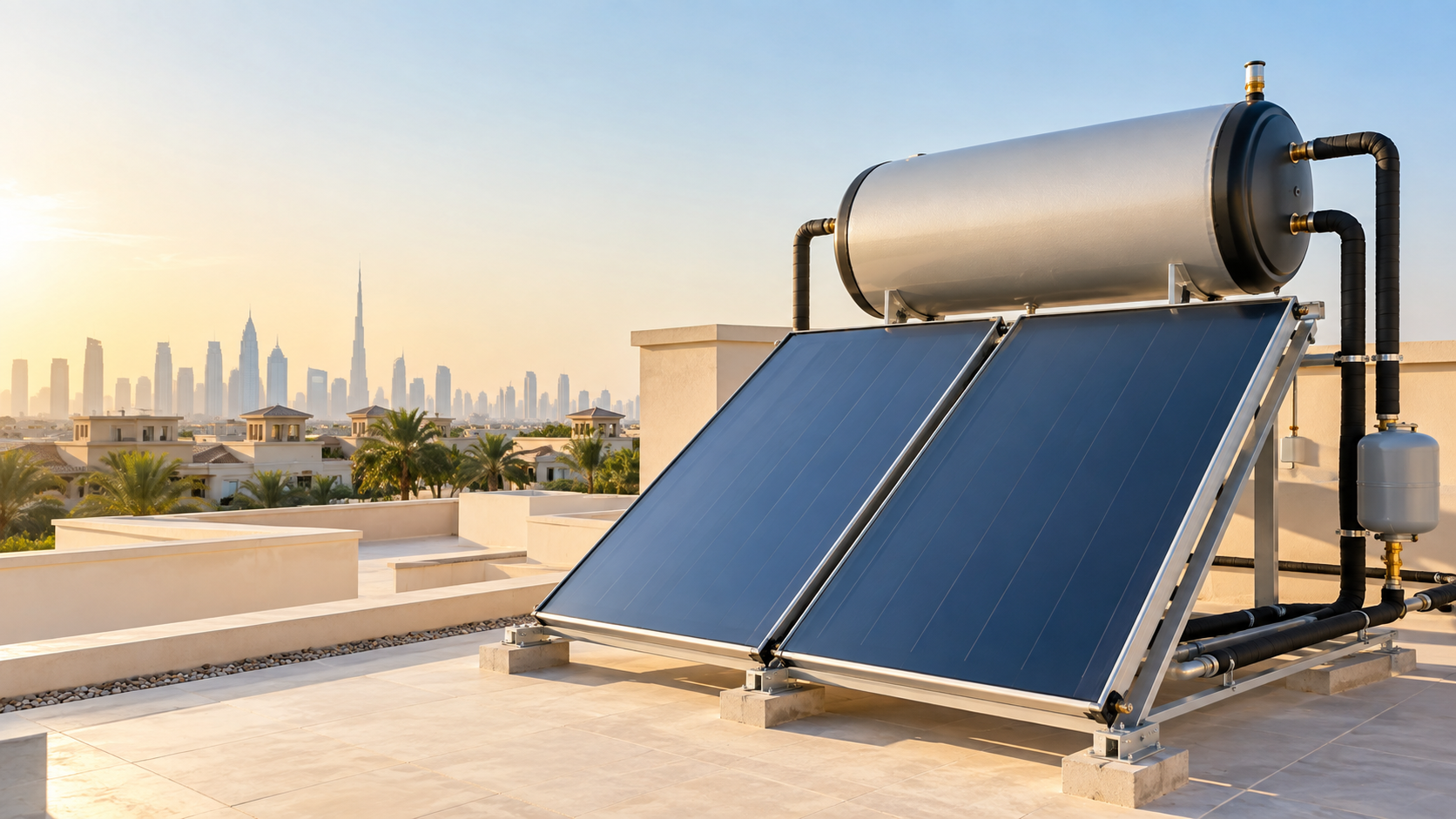
Start with the property, not a catalogue size
A solar water heater uses sunlight to heat water for later use. The installation decision begins with where the equipment could go, how much hot water occupants use and how the new system would connect with the property’s plumbing and backup heating. A picture of a roof cannot settle those questions. A site assessment should establish whether a practical installation is possible and what work would actually be required.
This page concentrates on a new solar hot water installation or replacement of an existing solar system. If your present system has stopped working, an inspection may reveal a repairable fault; our solar water heater repair and installation overview explains the wider service. Ask about repair before committing to replacement when the existing system might remain serviceable.
Solar water heating is different from photovoltaic solar panels. Solar thermal collectors capture heat for water. Photovoltaic panels produce electricity. A solar hot water proposal should therefore describe the collector, storage, plumbing and any backup heat, rather than treating it as a general rooftop electricity project.
Which properties may be suitable?
A suitable property needs an appropriate place for the equipment and a workable route into its hot water system. Villas often allow an owner or manager to discuss dedicated roof space, storage location and access directly. A commercial property may have greater or less predictable hot water demand, as well as facilities-management requirements. Suitability depends on the actual building and intended use, not merely the property type.
A roof or other mounting area must be assessed for available space, shading, orientation, structural considerations, waterproofing and safe future access. The position of the tank and the route for insulated pipework also matter. A site that looks sunny from the ground may have obstacles, equipment or access constraints that change the design. Nobody should declare a roof suitable from a photo alone.
For an apartment in a shared building, the hot water plant, roof and service routes may be common property. A resident normally needs the building owner or manager to identify the responsible system and approve access or alterations. A separately controlled, accessible system presents a different enquiry. Tell us who is responsible for the equipment before requesting an individual installation quote.
What a site assessment should establish
An installation quote is useful when it is based on the building and its actual hot water use. The assessment should connect the proposed equipment to the number of users, peak periods, existing storage and the outlets it must serve. It should identify how the current heater works and whether it will remain as backup, be modified or be removed. The specific checks and scope should be agreed with Dubai Pro Fixer when booking.
Hot water demand and storage
The number of occupants is a starting point, not a complete sizing formula. Consider how many showers or other hot water uses occur close together, the number of bathrooms, kitchen use and any unusual peak periods. For a commercial property, actual use records or an operations schedule may be more informative than a headcount. Storage capacity should be considered alongside the collector and backup arrangement, because a tank may need to serve demand outside the hours of strongest sunlight.
Space, mounting and access
The collector needs a suitable location with useful sunlight and an installation method appropriate to the building. Shading from nearby structures or rooftop equipment can reduce the available solar input. The tank may be integrated near the collector or located elsewhere, depending on system design. Either way, mounting, load, weather exposure, drainage, access for installation and future servicing deserve consideration. Roof penetrations and waterproofing details should be clarified in the proposed scope.
An assessment should also look at the route between the collector, storage and existing hot water distribution. Long or exposed pipe runs may affect heat loss and work scope, so insulation and protection matter. Ask where equipment will be placed, which areas need access and what reinstatement is included. If a building manager controls a roof or plant room, arrange that access before expecting a final quotation.
Existing plumbing and backup heat
The current heater, storage tank, valves and distribution pipework may influence what can be reused. Existing connections should not be assumed compatible with a new system. A backup electric heater or other source may be relevant for periods when solar input or stored hot water does not meet demand. The proposal should explain whether backup is included, retained, changed or outside the installation quote, and who will assess its condition.
Pressure protection, temperature control and any mixing arrangement also depend on the selected equipment and existing plumbing. Those details require a competent site-specific design and installation; this page does not prescribe a connection method. Ask how the installer will confirm proper operation and safe hot water delivery at handover.
Understanding the system options
The appropriate configuration depends on the roof, storage location, demand and existing services. The comparison below explains two broad approaches. It does not identify the products Dubai Pro Fixer supplies or recommend a particular option for your property.
| Configuration | General arrangement | What the site assessment must consider |
|---|---|---|
| Passive thermosiphon | Heat moves through the collector circuit by natural circulation, often with storage positioned near or above the collector | Mounting, tank location, available space, pipe route and building suitability |
| Pumped arrangement | A pump and controls circulate fluid between collector and storage, which may be in separate locations | Power and control arrangement, component access, pipe route and maintenance needs |
Some systems heat the water used at taps directly; others transfer heat through a separate circuit. Collector designs and storage arrangements also vary. A proposal should identify the actual components and explain why they suit the building. Do not assume every solar water heater has a circulation pump, or that equipment from an old system will work with a new one.
What the installation scope may include
The quote should state exactly what is included, rather than relying on the word “installation.” Depending on the site and selected system, work may involve mounting the collector and tank, connecting appropriate pipework, insulating exposed lines, integrating valves and controls, connecting to the property’s hot water arrangement, and addressing backup heating. Removal of existing equipment, access equipment and roof reinstatement should be listed separately where applicable.
The collector’s position and mounting method should be agreed in relation to sunlight, the building and safe access. Tank placement should allow the intended plumbing arrangement and future inspection. Routing should account for the distance between components and protection of the building fabric. If a new electrical connection or a change to backup heating is needed, clarify who is responsible and how it appears in the quote.
A complete proposal should also explain the commissioning and handover scope. Testing after installation can include the relevant connections, controls, circulation where applicable and hot water delivery. Some measures of solar contribution depend on suitable weather and ordinary use rather than a single reading immediately after work. Ask what can be demonstrated at handover and what should be observed over subsequent operation.
Before approval, identify what is outside the quote. Examples to ask about include building permissions, specialist access, structural changes, waterproofing repair, removal of old equipment and changes to unrelated plumbing. These are questions to resolve, not claims that every installation requires such work. If conditions found during work could change the price, agree how a revised scope will be explained and authorized.
First installation or replacement?
Installing a system where none existed and replacing an old one have different starting points. A first installation must establish an equipment location, mounting method, pipe route, integration with the hot water supply and backup strategy. A replacement begins with a real system whose condition, connections and previous performance can be inspected. The old layout may be useful, unsuitable or partly reusable; its existence does not guarantee compatibility with new equipment.
If an older system has failed, first ask whether a localized repair is viable. A leaking connection, failed control or other serviceable part may have a different solution from a damaged storage vessel or broadly deteriorated installation. Replacement may make sense where compatible parts are unavailable, repeated faults affect the wider system or the property’s demand has changed. Those are inspection-dependent decisions.
From enquiry to handover
A clear sequence helps you compare proposals and authorize the right work. Dubai Pro Fixer’s general website describes consultation, planning and quotation, execution and a final quality check for property services. Confirm the exact steps offered for your solar installation when you enquire.
Describe the property
Send the Dubai location, property type, whether this is a first installation or replacement, and a short description of current hot water supply and demand. Say who can arrange roof or plant-room access. A photo taken from a safe accessible position or a label on existing equipment may help start the conversation. There is no need to climb onto a roof or open electrical equipment to collect information.
Review the site and proposal
The appropriate assessment should connect hot water demand to usable space, mounting, storage, plumbing and backup heat. Ask for a proposal that identifies the system, components, major work, exclusions and conditions that could change the scope. If several arrangements are considered, compare their practical fit and maintenance implications as well as price. Confirm whether a diagnostic or site visit has a charge before booking.
Approve, install and check
Installation should follow the agreed specification and any required property access arrangements. If the work uncovers a condition that affects the scope, request an explanation and revised quotation before authorizing additional work. At completion, ask for a demonstration of relevant controls, what tests were completed, what operating behaviour to expect and which documents or product information will be provided. Agree whom to contact if a problem appears after handover.
What affects the price and schedule in Dubai?
There is no responsible fixed AED price or installation time for an unseen property. System size and configuration, collector and storage location, mounting, pipe length, existing heater condition, backup integration, site access and removal of old equipment can change the scope. A commercial property may need additional coordination with its facilities team and occupants. Component availability and approvals controlled by the property can also affect scheduling.
Ask for a quotation that separates equipment, installation labour, mounting, plumbing, any electrical or backup work, access arrangements, removal, commissioning and exclusions where relevant. A lower initial number may cover fewer tasks. A proposal based only on a system photograph may be preliminary; the onsite findings should determine the final scope. Compare quotations on what they actually deliver, not only the headline price.
Questions to ask before you approve
A good installation decision is easier when the quotation answers practical questions in plain language. Ask the provider:
- What demand assumptions support the proposed collector and storage arrangement?
- Where will the collector and tank go, and how will they be accessed later?
- Which existing plumbing and backup components will remain or be changed?
- What mounting, pipe insulation, roof or building work is included?
- Who arranges property permissions, access and any required specialist work?
- What is included in testing, commissioning, handover and removal of old equipment?
- Which documents, product details and maintenance guidance will be provided?
Dubai Pro Fixer and service coverage
Dubai Pro Fixer describes itself as a Dubai renovation and property maintenance company. Its website lists solar water heater repair and installation alongside plumbing, conventional water heater, water pump and maintenance services. The public contact page identifies Dubai, UAE as the service area. Confirm availability for your address, system and access arrangement when you enquire. We do not imply an office or guaranteed installation schedule in every community.
Original photographs of a real site assessment, equipment placement, installation work and finished system would help customers see the company’s actual work. A documented project could explain the property type, initial hot water requirement, assessment, selected arrangement, approved work and observed outcome. Such evidence should only be added when the company can substantiate it and the customer has allowed its use. An illustrative image should never be described as a completed job.
For an existing fault, the solar water heater overview explains repair and maintenance options. For connected work, see plumbing services, water heater repair and installation, and maintenance services. A separate domestic or building pump issue may fall under water pump repair and installation. These links help distinguish related needs rather than implying that they are automatically included in a solar installation quote.
Solar water heater installation FAQs
Is my villa suitable for a solar water heater?
Possibly, but suitability depends on usable mounting space, shading, access, structural and waterproofing considerations, the existing hot water arrangement and your demand. A villa roof may offer space without necessarily being appropriate for a particular system. Share your property details and request a site assessment before choosing equipment or assuming a system capacity.
How much roof space do I need?
There is no reliable single figure without a system selection and site survey. Collector area, tank arrangement, clearances, obstacles and safe service access all matter. Shading can also reduce useful exposure even where there is physical space. A proposal should show the intended location and explain how the equipment fits the available area and building conditions.
What size solar water heater should I choose?
The answer depends on expected hot water use, peak demand, storage needs and backup heating, not just the number of bedrooms. A household with concentrated morning demand may have different needs from a property with hot water use spread through the day. Ask how the proposed capacity was calculated and what assumptions the provider made.
Can a solar water heater be installed in an apartment building?
An individual installation depends on who controls the roof, hot water system and service routes. Many buildings have shared equipment and require the owner or building manager to authorize alterations. If your apartment has a separately controlled system, describe it and establish who can approve the work. Do not arrange roof access or changes to shared plant without the responsible party.
Will I have hot water when sunlight is limited?
That depends on stored hot water, demand and any backup heating included in the system. Solar contribution changes with conditions, while storage can provide water heated earlier. A proposal should explain the intended backup arrangement and its role when solar input is insufficient. It should not promise a fixed solar contribution or energy saving for an unassessed property.
What is the difference between a passive and pumped system?
A passive thermosiphon arrangement uses natural circulation; a pumped arrangement moves fluid with a pump and controls. Their component locations, mounting and servicing needs can differ. The right approach depends on the building and selected equipment. Ask the provider which configuration is proposed, why it suits the property and what components require future maintenance.
Can I replace only my old tank or collector?
Sometimes a component replacement is possible, but compatibility and the condition of retained parts must be assessed. Existing connections or mounting should not be assumed suitable for a new component. If one part has failed, ask whether the rest of the installation is serviceable and what the quotation covers. A repair assessment may also reveal a smaller scope.
How much does installation cost in Dubai?
The price depends on equipment size and type, roof and tank locations, mounting, pipework, backup integration, access and any removal of old equipment. An accurate quotation needs property details and usually an onsite assessment. Ask for an itemized scope and identify exclusions or conditions that could change the price; avoid comparing proposals by total alone.
How long will installation take?
The schedule depends on the approved scope, access, equipment availability and any building coordination or other work required. A first installation can differ from replacing a system with existing connections, and either may uncover additional conditions. Ask for separate estimates for assessment, sourcing and onsite work after the property has been reviewed.
What maintenance will the system need?
Maintenance depends on the installed design and manufacturer guidance. Appropriate checks may include visible leaks, insulation condition, controls, circulation where fitted and collector condition, with safe professional access where needed. Ask what inspections the selected equipment calls for and what observations you can make from an ordinary accessible location. Do not climb onto a roof or open pressurised or electrical equipment yourself.
What should I prepare for a site assessment?
Share the property location, type, approximate hot water use, number of outlets, current heater arrangement and whether you are replacing an old solar system. Explain who controls roof or plant-room access. Existing equipment details and safe-to-take photos can be useful. You do not need to measure a roof or diagnose plumbing before contacting the company.
How do I request an installation quote?
Call 052 460 1612, send a WhatsApp message, or use the Dubai Pro Fixer contact page. Tell the team where the property is, whether the system is new or a replacement, and how access can be arranged. Ask what information and assessment are needed for a site-specific proposal.
Discuss your solar hot water project
A useful installation starts with your property and the hot water it needs to supply. Describe your villa or managed building, current heater and intended use, and ask Dubai Pro Fixer about the next step for a site assessment and quotation. Call 052 460 1612, contact us on WhatsApp, or send an enquiry online.