
Bioclimatic Pergola Dubai Louvered & Retractable Pergolas by Dubai Profixer
Adjustable louver blades, retractable roofs and smart controls — a pergola that adapts to Dubai's sun, heat and sudden rain. Ideal for villas, rooftops, gardens and restaurants.
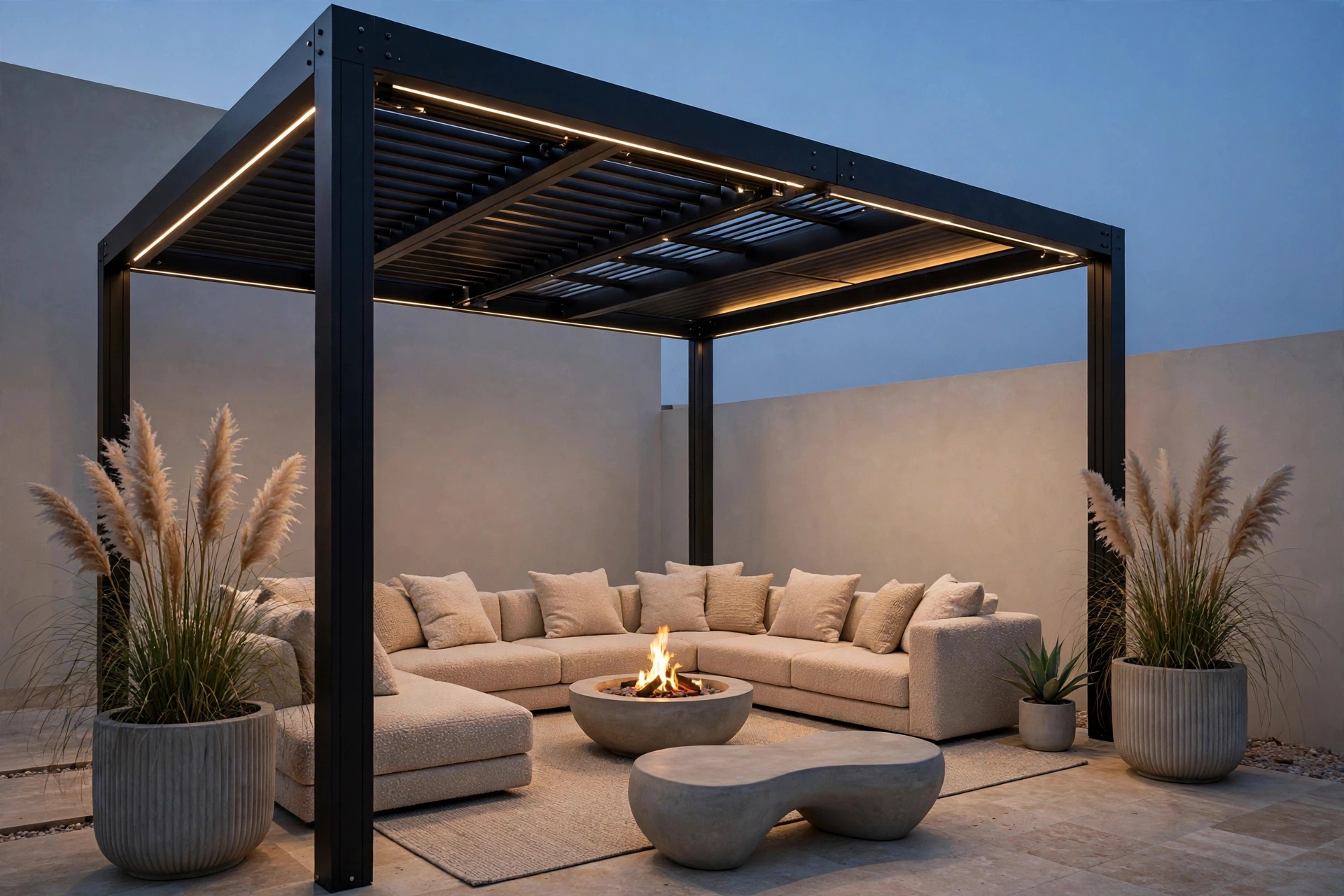
Dubai loves outdoor living — evening majlis gatherings, poolside afternoons, rooftop dinners under the stars. The problem is the climate: fierce midday sun for most of the year, humidity in late summer, and the occasional dramatic downpour. A fixed pergola gives you one answer to all of that: permanent partial shade. A bioclimatic pergola gives you every answer. Open the louvers to catch the winter sun and the evening breeze. Tilt them to block the afternoon glare while keeping airflow. Close them fully when rain arrives, and the roof seals into a watertight cover with water channelled away through hidden gutters. It is the closest thing to bringing indoor climate control outdoors — and it has become the premium choice for Dubai villas, penthouses, restaurants and hotels that take their outdoor spaces seriously.
What Is a Bioclimatic Pergola?
The word "bioclimatic" comes from architecture: designing with the climate rather than against it. A bioclimatic pergola applies that idea to your garden or terrace. Instead of a fixed roof, it has a roof of adjustable blades — called louvers — mounted in a sturdy aluminium frame. Rotate the louvers and you change the microclimate underneath: sunlight in or out, breeze through or blocked, rain kept off. The structure responds to the weather and to what you want at that moment, rather than forcing one compromise all year.
In practice, most bioclimatic pergolas in Dubai are louvered-roof systems, and that is what we build most often. The frame and blades are powder-coated aluminium — light, strong, corrosion-resistant, and well suited to heat and humidity. Some designs use a retractable fabric roof instead of rigid blades, which folds away to give a fully open sky. Both count as bioclimatic because both let you tune the space to the conditions. What they share is adjustability: the roof is a control surface, not just a cover.
It helps to think of it as the difference between a window and a wall. A fixed pergola roof is a wall — it does one thing. A bioclimatic roof is a window with blinds you can angle, open or shut. In a city where the difference between January and August is the difference between sweater weather and 45-degree afternoons, that adjustability is not a luxury extra. It is the difference between an outdoor space you use four months a year and one you use twelve.
How Louvered Roof Blades Work
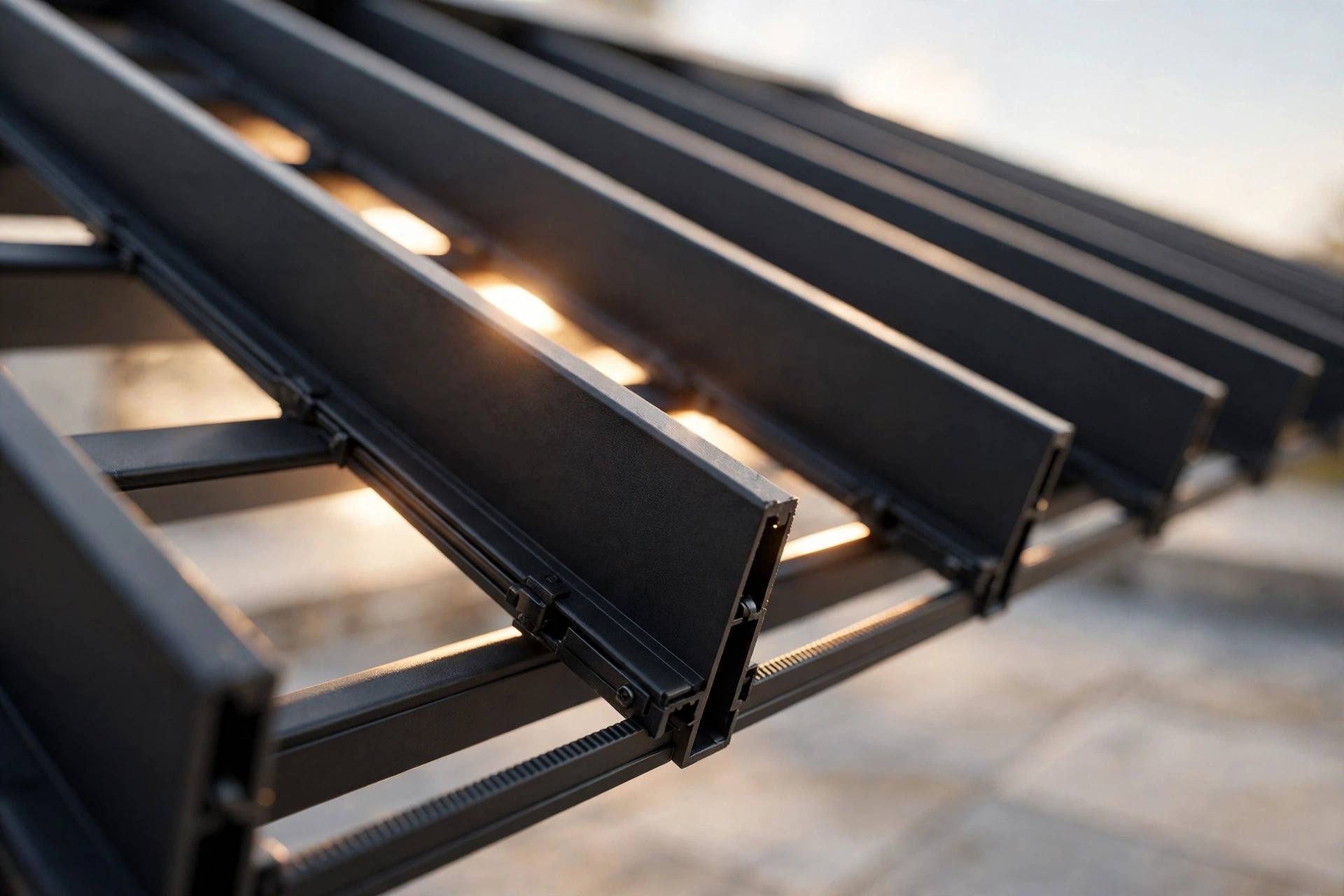
The louver blades are wide aluminium slats — typically around 20cm across — pivoted along their long edges inside the pergola's roof frame. A concealed mechanism rotates every blade in unison, usually through a range of about 135 degrees. At one end of the range the blades stand open like venetian blinds tilted to vertical: sunlight streams through, hot air rises and escapes, and you get the feeling of open sky with the structure's framing. At the other end they lie flat and overlap, interlocking into a continuous sealed surface.
Between those extremes is where the system earns its name. Angle the blades at 45 degrees and you block direct sun while letting air circulate — the classic hot-afternoon setting. Angle them to track the sun through the day and the shaded zone follows you. Each position is a different microclimate, and changing it takes seconds with a remote control.
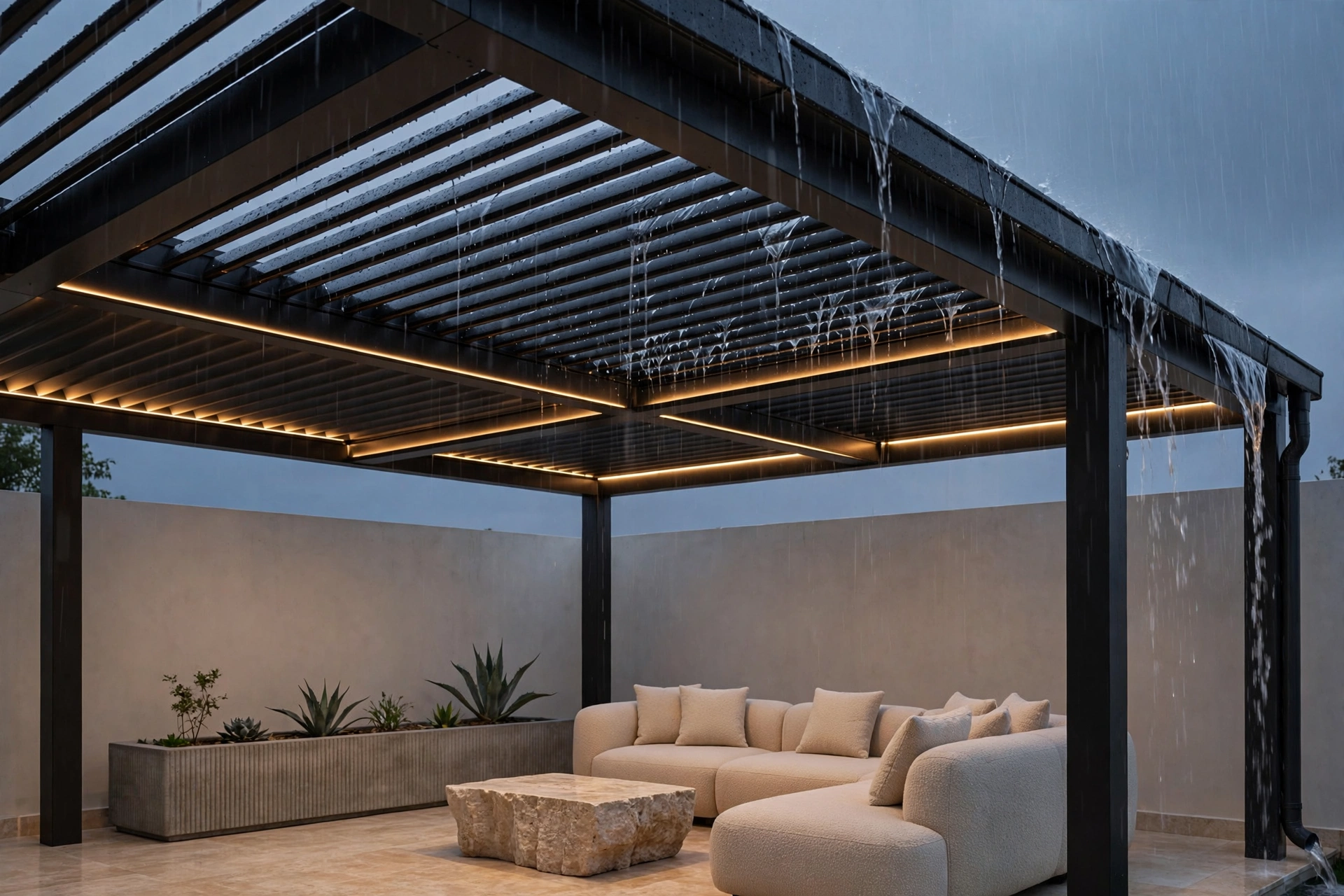
When the blades close fully, they do more than block light. Each blade has a shaped profile with a drip edge, so water landing on the closed roof runs along the blades into perimeter gutters built into the frame, then down through hollow posts to ground level or a drainage point. Done properly, a closed louvered roof sheds rain like a solid roof — your furniture stays dry and dinner continues. That is why the sealing quality of the blades and the capacity of the guttering matter so much in the design: a louvered roof is only as waterproof as its drainage detailing.
One honest note: no louvered roof is magic. In wind-driven sideways rain, some mist can enter at the edges, and in a true shamal the sensible move is to open the blades to let wind pass through rather than fight it. A good installer designs for this — adequate gutter capacity, sensible blade positioning guidance, and structural engineering for the site's wind exposure. Ask about all three before you commit to any system.
Retractable Roof Options
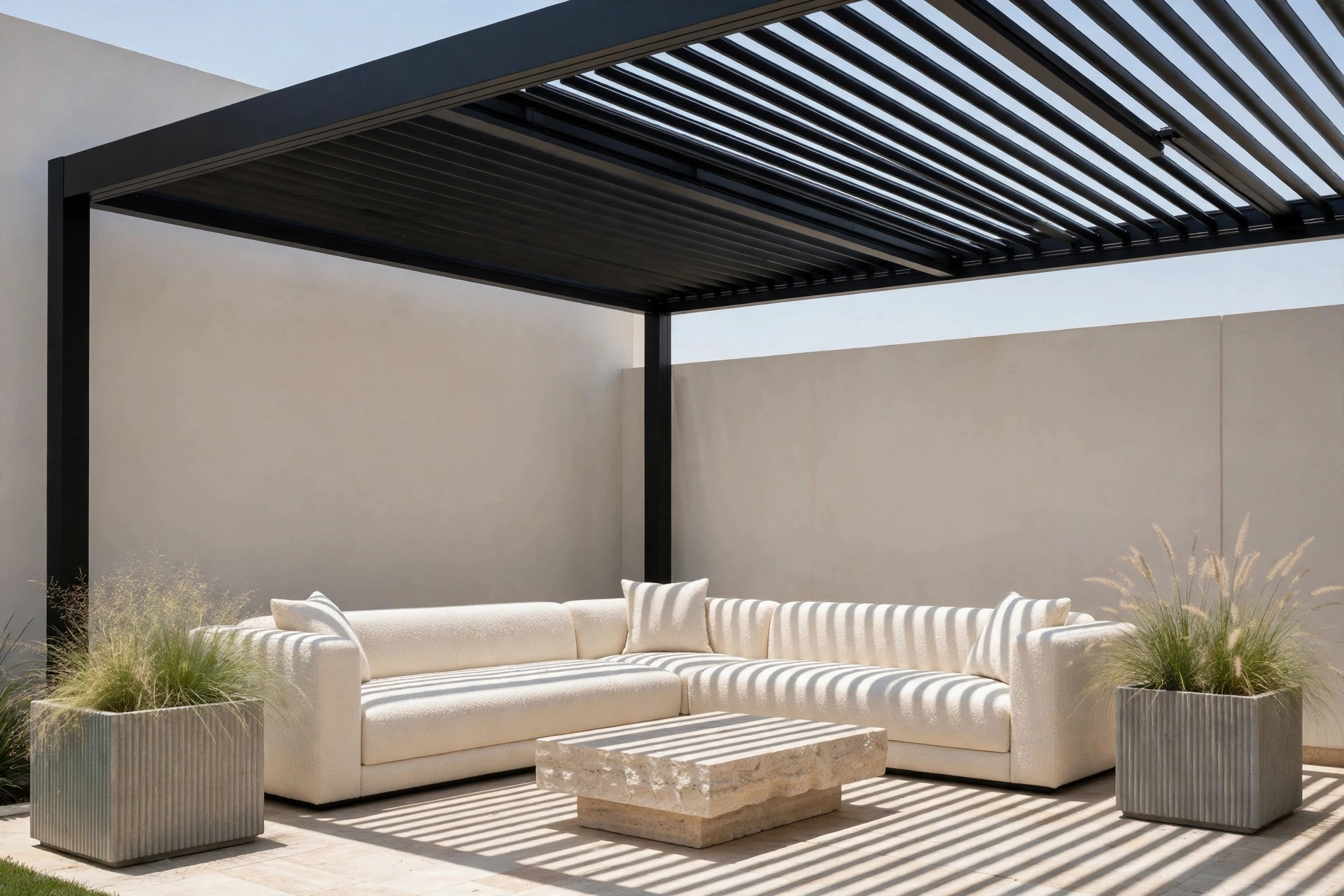
Not every bioclimatic pergola uses rigid blades. Retractable-roof pergolas use a tensioned waterproof fabric that slides along tracks to open or close the roof — sometimes fully, sometimes partially. Think of a convertible car roof scaled up to terrace size. Fully open, there is nothing between you and the sky; fully closed, you have a waterproof fabric canopy.
Retractable fabric suits situations where you want the dramatic open-sky feeling that blades, even open, can't quite give — open blades still show the frame's rhythm overhead, while a retracted fabric roof disappears almost entirely. It also suits curved or irregular footprints where rigid blades are harder to fit. The trade-off is that fabric gives you open-or-closed (and positions between) rather than the fine tilt control of louvers, and the fabric needs periodic cleaning to stay sharp in Dubai's dusty air.
Which is right for you? If your priority is daily climate control — managing sun angle through the day, keeping airflow while blocking glare — louvered blades give finer control and a more architectural look. If your priority is the wow factor of a fully open sky for evening entertaining, with simple open/close operation, a retractable roof delivers it. Some larger projects combine both: louvered zones over seating areas, retractable sections over dining. During design we walk through how you actually use the space — morning coffee, afternoon shade, evening dinners — and match the roof system to those moments.
Motorized & Smart Controls
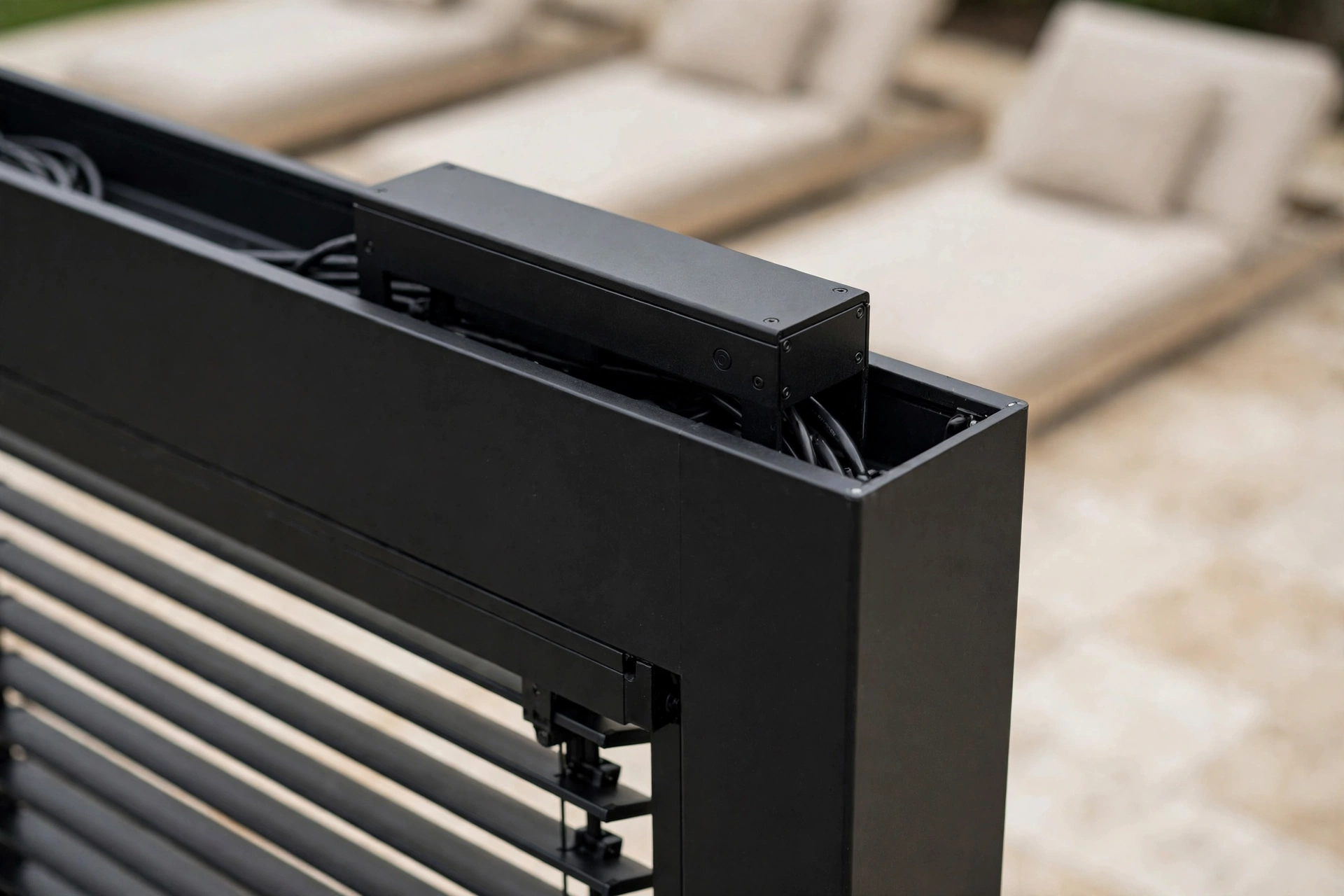
Bioclimatic pergolas are normally motorized — adjusting a 5-by-4-metre roof by hand crank belongs to the past. A quiet electric motor drives the blades or the retractable fabric, operated by a handheld remote or a wall-mounted switch. From your sofa, you tilt the louvers as the sun moves. That alone transforms how the space gets used, because the barrier to adjusting it drops to zero.
Beyond the remote, control options layer up. Smartphone app control lets you adjust the roof from anywhere — close it from the office when you see rain coming. Automated sensors are a popular add-on: a rain sensor can close the roof at the first drops, a wind sensor opens the blades or retracts the fabric when gusts exceed a safe threshold, and a sun sensor adjusts blade angle through the day. Ask us which options are available for your build. Timers and scenes — "evening mode" tilting blades for sunset light, for example — round out the smart package.
A word of honest advice on the smart layer: start with what you'll actually use. Most owners use the remote daily; many add a rain sensor for Dubai's sudden winter downpours and a wind sensor as cheap insurance for exposed installations. App-and-voice integration is available on some systems and genuinely useful if your home already runs on a smart setup — ask us about the control options for your build. Automation should disappear into daily life, not become a hobby.
Handheld Remote
The everyday control — open, close, tilt from anywhere in the space.
Wall Switch
A fixed control point by the door to the terrace or garden.
Rain Sensor
An optional add-on that closes the roof automatically at the first drops — furniture stays dry. Ask about availability for your build. even when you're out.
Wind Sensor
An optional add-on that opens blades or retracts fabric in strong gusts to protect the mechanism. Ask about availability for your build..
App Control & Timers
Adjust from anywhere, schedule positions through the day.
Aluminium Construction for Dubai's Climate
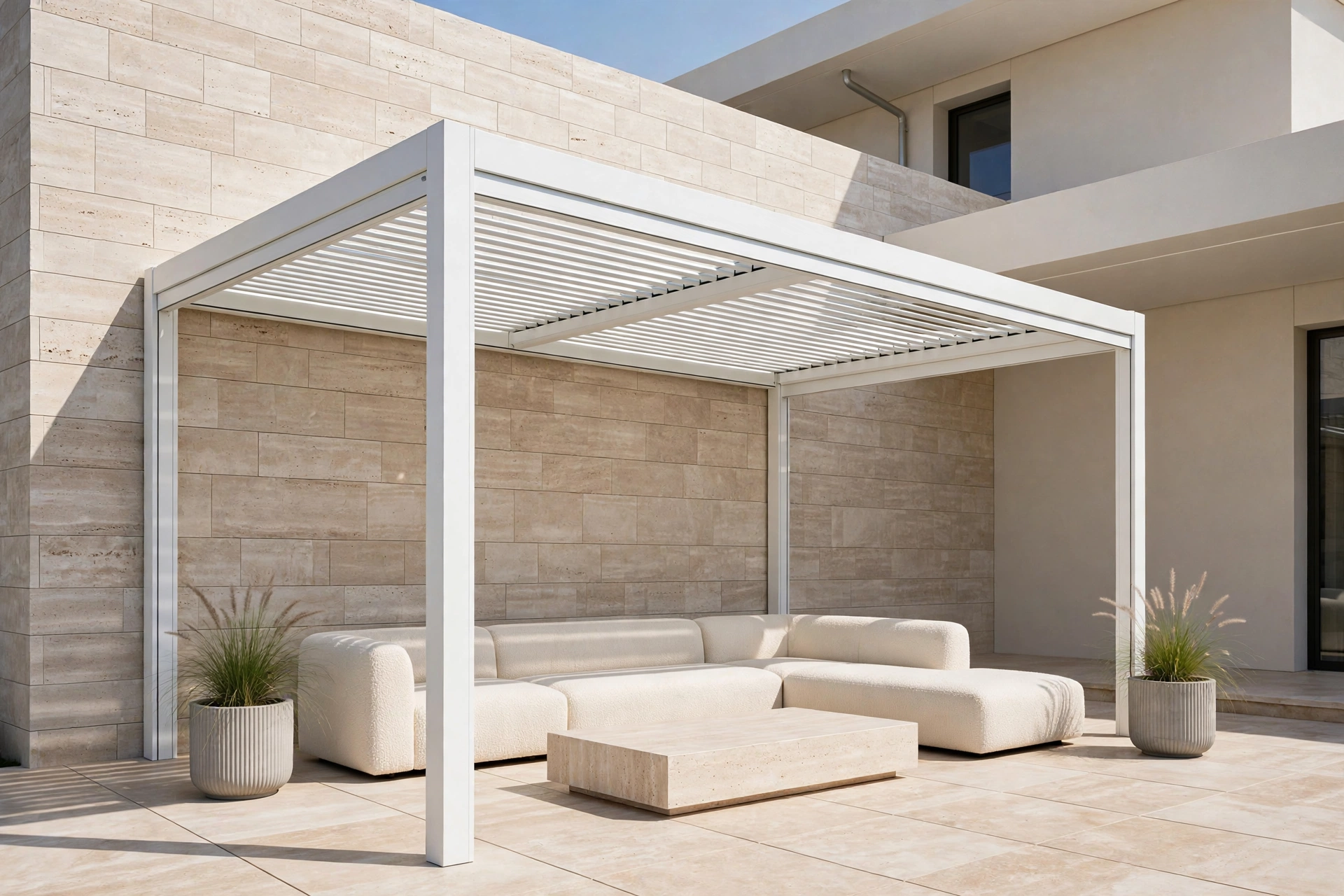
Bioclimatic pergolas are aluminium structures, and in Dubai that is a genuine advantage. Powder-coated aluminium doesn't rust, doesn't warp in heat, and shrugs off the humidity of late summer. The powder coating — a baked-on coloured finish — resists fading under UV far better than paint, and it comes in a wide palette: whites and sands for the classic villa look, charcoals and blacks for modern minimalism, and wood-effect finishes for warmth without wood's maintenance.
The engineering matters as much as the material. A louvered roof is a moving mechanism carrying wind load, so the frame, fixings and foundations need proper structural design — not guesswork. Freestanding installations need correctly sized footings; wall-mounted versions need sound fixing into the building structure. This is the unglamorous part of a bioclimatic pergola and the part that separates a system that runs smoothly for years from one that starts sticking in its second summer.
Maintenance is refreshingly light compared to timber: occasional washing of the frame and blades to remove Dubai's fine dust, keeping gutters and drainage channels clear, and a periodic check that the mechanism runs smoothly. No sanding, no staining, no oiling — the main reason aluminium dominates the premium pergola market here. If you're comparing materials more broadly, our aluminium pergola page goes deeper on finishes and options.
Sun, Rain & Wind Protection
Sun. This is the daily job. The blades' tilt range lets you block direct sun at any angle while keeping reflected light and airflow — the space stays bright but not blinding, shaded but not stuffy. In peak summer, closing the blades fully during midday creates deep shade; the aluminium reflects a good portion of radiant heat, and with the blades tilted for ventilation, hot air escapes upward instead of pooling. It won't feel air-conditioned — it's still outdoors in August — but the difference between direct sun and managed shade is the difference between unusable and pleasant.
Rain. Dubai's rain arrives rarely but dramatically. Closed blades interlock into a sealed surface, and the integrated gutter system carries water to the posts and away. Your outdoor furniture, cushions and dinner survive the downpour. The honest caveat: in wind-driven rain, fine mist can drift in at the open sides — a bioclimatic roof is a roof, not a room. Side screens or glass sliding panels can enclose the space further if you want true all-weather use.
Wind. This is where the adjustability becomes a safety feature rather than a comfort one. A fixed solid roof catches wind like a sail; a louvered roof can be opened to let gusts pass through the structure. Wind sensors can automate this on compatible systems — when gusts exceed the set threshold, the system opens the blades or retracts the fabric on its own. Ask us about the options for your build. For rooftop installations, which catch more wind than sheltered gardens, correct structural engineering and sensor protection are non-negotiable parts of the design. If a contractor waves away wind loading on a rooftop louvered pergola, find another contractor.
Bioclimatic vs Fixed-Roof Pergola
Should you pay the premium for adjustability, or will a fixed roof do? An honest comparison:
| Factor | Bioclimatic (Louvered / Retractable) | Fixed-Roof Pergola |
|---|---|---|
| Climate control | Adjust sun, shade and airflow through the day and seasons | One fixed level of shade, all year |
| Rain protection | Closes into a sealed, guttered roof | Depends on roof material; solid roofs protect, open rafters don't |
| Winter sun | Open the blades and enjoy it | Fixed shade blocks welcome winter sun too |
| Evening sky | Open fully for stargazing dinners | Roof always overhead |
| Cost factors | Higher — mechanism, motor, engineering | Lower — simpler structure |
| Maintenance | Light: cleaning plus mechanism checks | Minimal for aluminium; more for timber |
| Best for | Daily-use outdoor living, dining areas, rooftops, restaurants | Simple garden shade, budget-conscious projects, decorative structures |
The rule of thumb: if the pergola covers a space you'll use daily — the terrace where you eat, the lounge where the family gathers — the bioclimatic premium pays back in usable hours. If it's decorative shade over a garden path or a seating corner used occasionally, a fixed aluminium pergola or standard pergola does the job for less. We build both, and we'll tell you honestly which suits your brief — there's no point selling adjustability to someone who needs a simple shade sail's job done.
Furnishing Your Bioclimatic Pergola
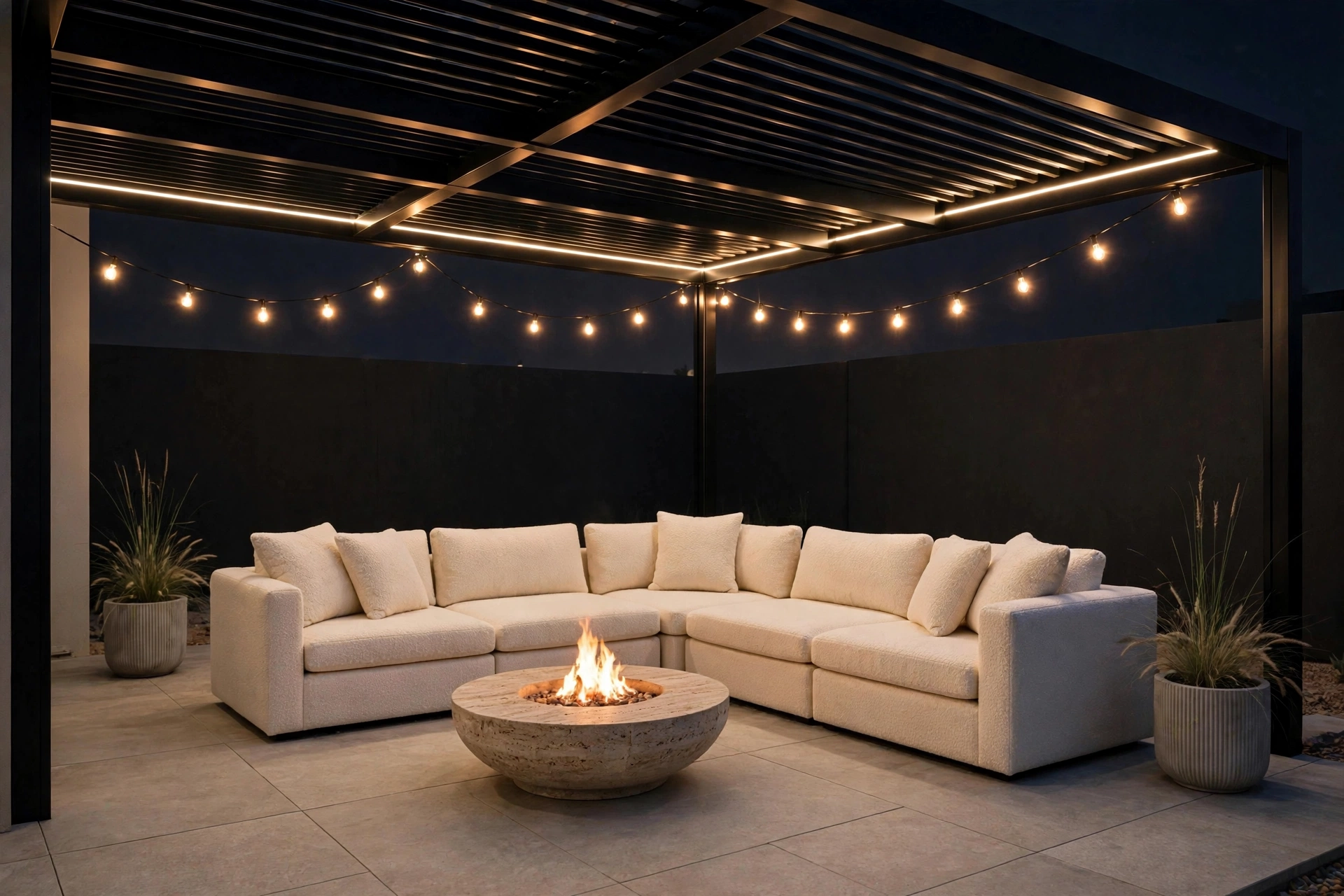
A bioclimatic pergola begs to be furnished like an outdoor room — because with climate control overhead, it genuinely functions as one. The most successful setups zone the space: a lounge area with deep outdoor sofas under one bay of louvers, a dining set under another, so each zone's shade can be tuned independently. Weather-resistant furniture is essential — powder-coated aluminium frames, solution-dyed acrylic fabrics, and teak or composite tables stand up to Dubai's sun and the occasional rain the closed roof mostly keeps off.
Layer in the details that make evenings work: warm LED strip lighting tucked into the pergola frame, a ceiling fan mounted to a reinforced beam for still summer nights, and outdoor-safe power points for lamps and chargers. Because the roof closes against rain, you can be more generous with soft furnishings — outdoor rugs, throws and cushions survive far better under a louvered roof than under open sky. See our furnished pergola page for the full approach to designing structure and furniture as one space.
Zone the Space
Lounge under one bay, dining under another — tune each independently.
Weather-Proof Furniture
Aluminium frames, solution-dyed fabrics, teak or composite tops.
Light It Warm
2700–3000K LED strips in the frame; dimmable for evening mood.
Add a Fan
A ceiling fan on a reinforced beam transforms still summer evenings.
Plan Power
Outdoor-rated sockets for lamps, heaters and device charging.
Choosing the Right System
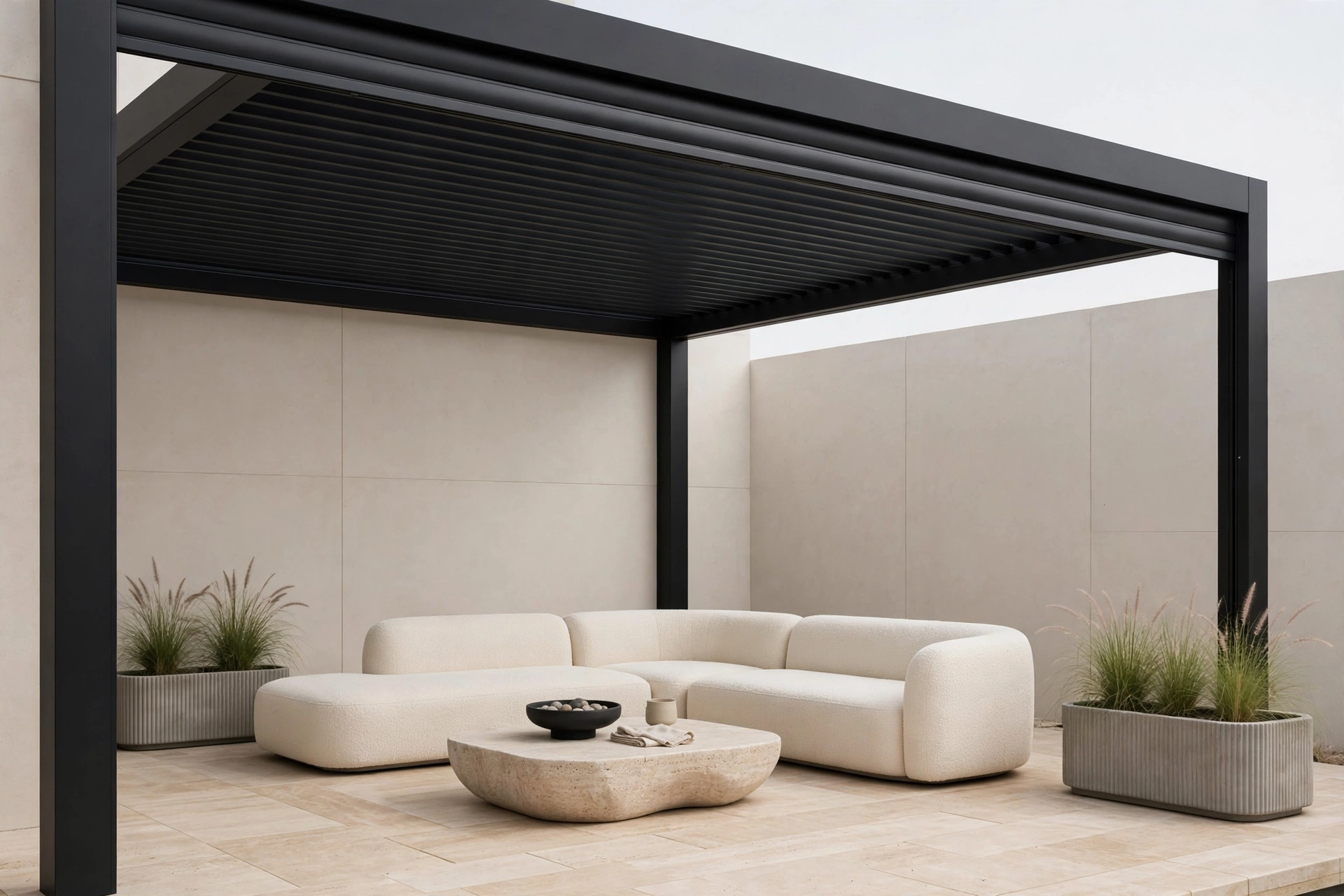
Getting a bioclimatic pergola right is mostly about the decisions before manufacturing starts. Attached or freestanding? Wall-mounted systems bolt to the villa and suit terraces and patio doors — one row of posts, a cleaner look, usually lower cost. Freestanding systems stand anywhere — mid-garden, poolside, on rooftops — with four or more posts and full design freedom. Size follows use: a 3×4m bay covers a dining set; 4×6m handles lounge plus dining; restaurants often run multiple bays in a row.
Orientation matters more than most expect. In Dubai, the harsh sun comes from the south and west in the afternoon — blade tilt handles much of this, but positioning the structure with its long axis east-west gives the louvers the best sun-blocking geometry. Drainage needs a plan: water leaves through the posts, so it has to go somewhere sensible at ground level. And permissions: many Dubai communities and villa developments have guidelines for outdoor structures — check your community's rules before building, as requirements vary by developer.
Finally, judge the system by its details, not its brochure. Ask to see the blade profile and how it seals; ask about gutter capacity and where water exits; ask what happens in a power cut (manual override should exist); ask about the wind rating and whether a wind sensor is included; ask how the mechanism is serviced if it ever needs attention. A bioclimatic pergola is a precision product — the difference between a good one and a cheap one shows up in year two, not on installation day. For villa-wide outdoor planning, see our villa pergola page.
Timing depends on scope, materials and site conditions — a straightforward single-bay installation moves faster than a multi-bay rooftop system with drainage works. When you request a quote, share your space's dimensions, photos, and how you want to use it; that's what lets us design accurately and price honestly.
Bioclimatic Pergola FAQs
Ready for Year-Round Outdoor Living?
Send us your space dimensions and a few photos — we'll design a louvered or retractable pergola around how you actually live outdoors, and prepare your quote.
Request a Quote