
Wall Cladding Dubai — Stone, Tile & Wood Cladding by Dubai Profixer
Dubai Profixer installs stone, porcelain tile and timber-look wall cladding across Dubai — villa facades, entrances, boundary walls, poolside walls, bathrooms and kitchens. Engineered for UAE heat, sand and humidity. Request a quote on WhatsApp.
On This Page
Think of cladding as the wall's armour and its outfit at the same time. Where interior panelling simply decorates, cladding protects — it stands between your building and the sun, the sand, the moisture and the everyday knocks, while wearing a finished face of stone, porcelain or timber. On a villa facade, the difference is stark: painted render chalks and fades under Dubai's UV within a few years, while a stone-clad facade looks better in twenty years than the day it was installed. That permanence is exactly why cladding is standard on premium villa developments across the emirate — and why boundary walls, entrance portals and poolside walls are increasingly getting the same treatment.
In Dubai, cladding earns its keep every single day. Relentless ultraviolet light destroys paint; sand-laden winds scour soft surfaces; humidity spikes attack whatever they can reach; and peak summer heat cycles expand and contract every material on the building. A properly specified and properly fixed clad wall shrugs all of this off. Stone and porcelain are effectively permanent materials — they need minimal maintenance, they resist abrasion, and they insulate the building behind them, which matters when the air-conditioning runs for most of the year. Cladding is not decoration applied to a wall. It is the wall's final, permanent face — and choosing the right material and the right fixing system for your exposure is what this guide is about.
How to Choose the Right Cladding
Cladding is a system, not just a surface — the stone or tile you see is only half the story. The fixing method, the substrate and the exposure matter just as much. These are the decisions to get right before anything is ordered:
- Start with exposure: full-sun facades need UV-stable stone or porcelain; shaded garden walls have more options; wet areas like bathrooms and poolsides demand fully waterproof systems with tanking behind the finish.
- Match the architecture: contemporary villas suit large-format porcelain and clean limestone; traditional and Mediterranean designs suit sandstone warmth and slate texture. The cladding should feel like it belongs to the building, not stuck onto it.
- Consider weight: natural stone is heavy, and the structure must carry it. On weight-limited walls, porcelain panels and lighter systems give the stone look without the structural demand.
- Think maintenance honestly: porcelain is essentially wipe-and-forget; porous stone needs periodic resealing. Be realistic about the care you'll actually do — the best cladding is the one you'll maintain.
- Budget the whole system: cladding cost is never just the material. Fixing systems, scaffolding for high walls, waterproofing, sealing and detailing are all significant — always quote the complete installed system.
- Sample at scale: natural stone varies enormously from batch to batch. Approve large samples — ideally a trial panel fixed to your own wall — before committing to hundreds of square metres.
This is also where a site assessment pays for itself. A wall that looks ready may hide damp, loose render or structural movement — any of which must be resolved before cladding goes up. We assess the substrate, the exposure and the structure first, then recommend materials that suit your wall, your architecture and your maintenance appetite. For design direction alongside the cladding itself, see our wall design Dubai services.
Cladding Materials Compared
Four material families cover almost every cladding project in Dubai. Each has a distinct character, and each has exposures where it shines and exposures to avoid:
| Material | Character | Dubai Notes |
|---|---|---|
| Travertine & limestone | Warm, natural, timeless; soft earthy tones | Excellent exterior choice — UV-stable and ages beautifully; seal against staining |
| Slate & sandstone | Textured, rustic, full of character | Ideal for boundary walls, garden walls and entrance portals; specify hard grades for sandstorm-facing walls |
| Marble & granite | Luxurious, bold, polished or honed | The premium statement — best for features and interiors; seal marble outdoors and clean spills promptly |
| Porcelain (stone-look tile) | Uniform, stain-proof, lighter than stone | The superb all-rounder — facades, wet areas, interiors; fade-proof and effectively maintenance-free |
| Wood & timber cladding | Warm, natural, architectural | Beautiful for sheltered features and interiors; needs UV-protective finishing and periodic care in Dubai sun |
| PVC & HPL panels | Modern, hygienic, consistent colour | Great for commercial interiors, clinical spaces and budget-conscious wet areas; lightweight and easy to clean |
Notice what's missing from the "character" column: a universal winner. Porcelain wins on maintenance and consistency, natural stone wins on presence and prestige, wood wins on warmth, PVC wins on hygiene and value. The right answer depends on your wall's exposure, your architecture and how you want the building to feel in ten years. Our sustainability view is simple too: the greenest cladding is the one you never replace — a stone facade that serves for fifty years with minimal upkeep has a far lower lifetime footprint than painted render redone every few years, and stone and porcelain both insulate the building, trimming cooling loads in Dubai's climate.
Exterior Cladding in Dubai's Climate
Dubai's climate is a stress test for building exteriors — intense summers, sandstorms, humidity spikes and relentless UV. Our cladding specification accounts for all of it, because the material is only as good as the system behind it:
UV Resistance
Natural stone and quality porcelain are inherently UV-stable — their colours don't fade where paint chalks and bleaches within a few years. A clad facade keeps its colour decade after decade.
Thermal Movement
Dubai's heat cycles expand every material. Large-format cladding needs proper expansion joints and flexible adhesives — a rigid system with no allowance will crack. We detail joints into the design, not as an afterthought.
Sandstorm Abrasion
Hard stone and porcelain resist the scouring that strips paint and soft render during shamal winds. On sandstorm-facing elevations we specify harder grades and denser materials.
Moisture Management
Ventilated fixing systems let the wall breathe behind the cladding. Sealed systems that trap moisture fail — the invisible detailing behind the stone decides whether the facade lasts decades or blisters within years.
Correct Sealing
Porous stones — travertine, limestone, sandstone — are sealed against staining and moisture uptake. Dense porcelain needs no sealer at all; sealing it is unnecessary and can cause hazing.
Mechanical Fixing
Heavy stone on facades needs mechanical fixing — adhesive alone fails, dangerously. We never rely on adhesive-only fixing for exterior stone, whatever the shortcut costs.
Cladding Applications We Build
Cladding works anywhere a wall needs protection, presence or both. These are the six applications we build most across Dubai:
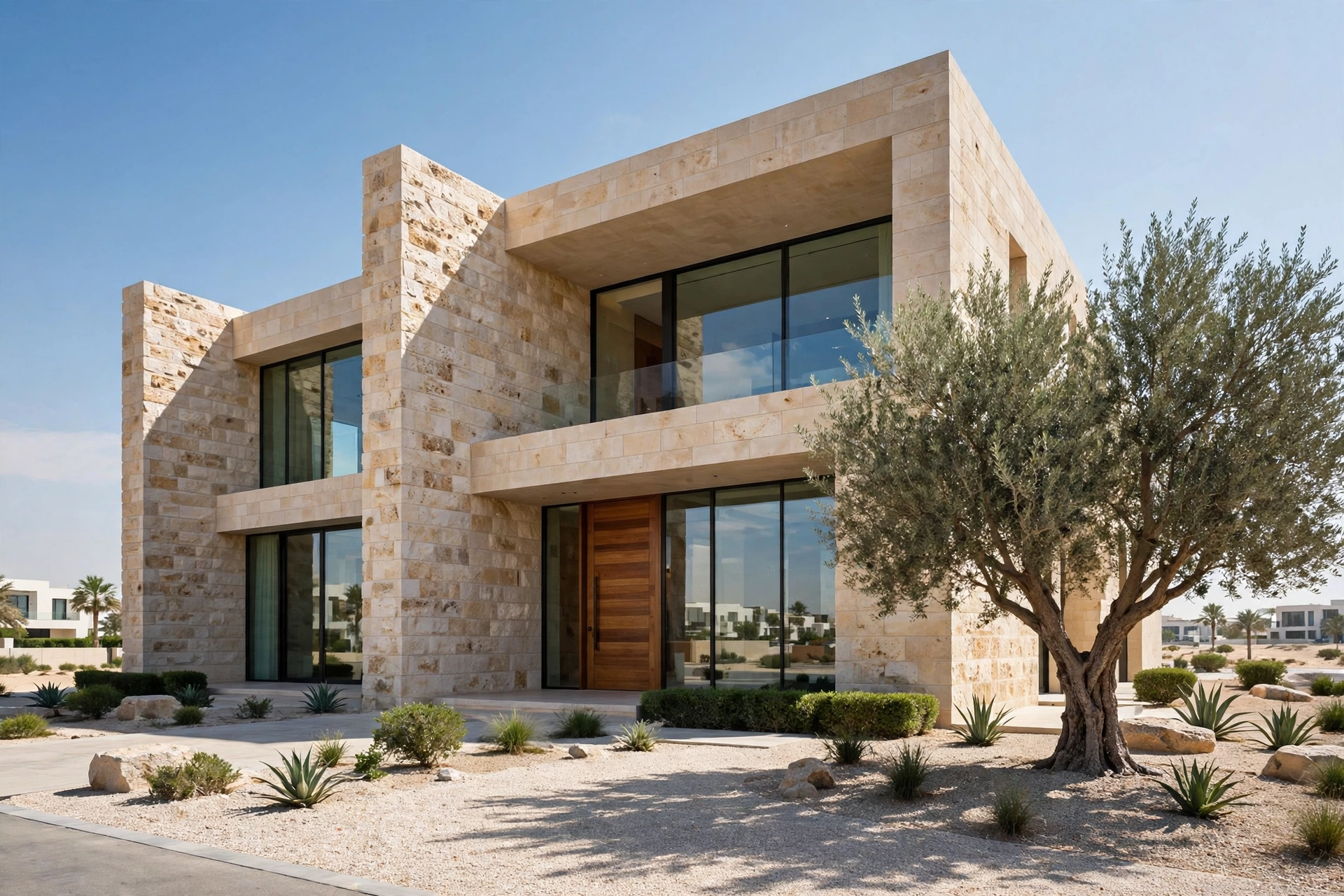
1. Villa Facade Cladding
The ultimate curb appeal: full or partial facade cladding in travertine, limestone or sandstone. Stone facades age gracefully where paint fades — they need no repainting, resist sandstorm abrasion, and give the villa a permanence that defines premium neighbourhoods. We install with proper mechanical fixing and ventilation detailing for Dubai's heat, including scaffolding and full site management.
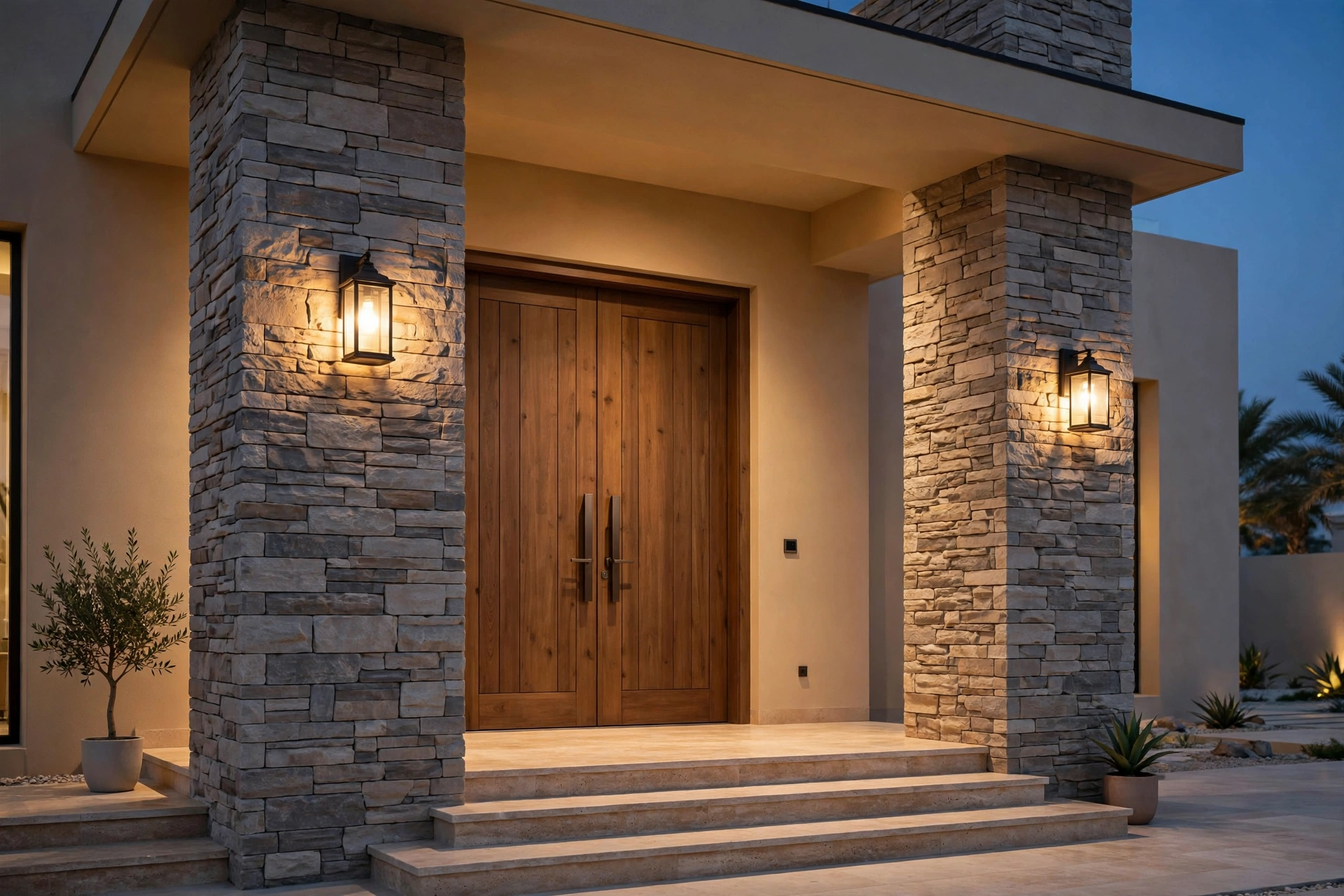
2. Entrance & Portal Cladding
The entrance deserves the best stone on the property. Stacked slate, book-matched marble or textured limestone portals create arrivals with real presence — especially with integrated lighting washing the texture at night. A clad entrance tells every visitor the whole property was built with intent, and it's the single most photographed part of any villa.
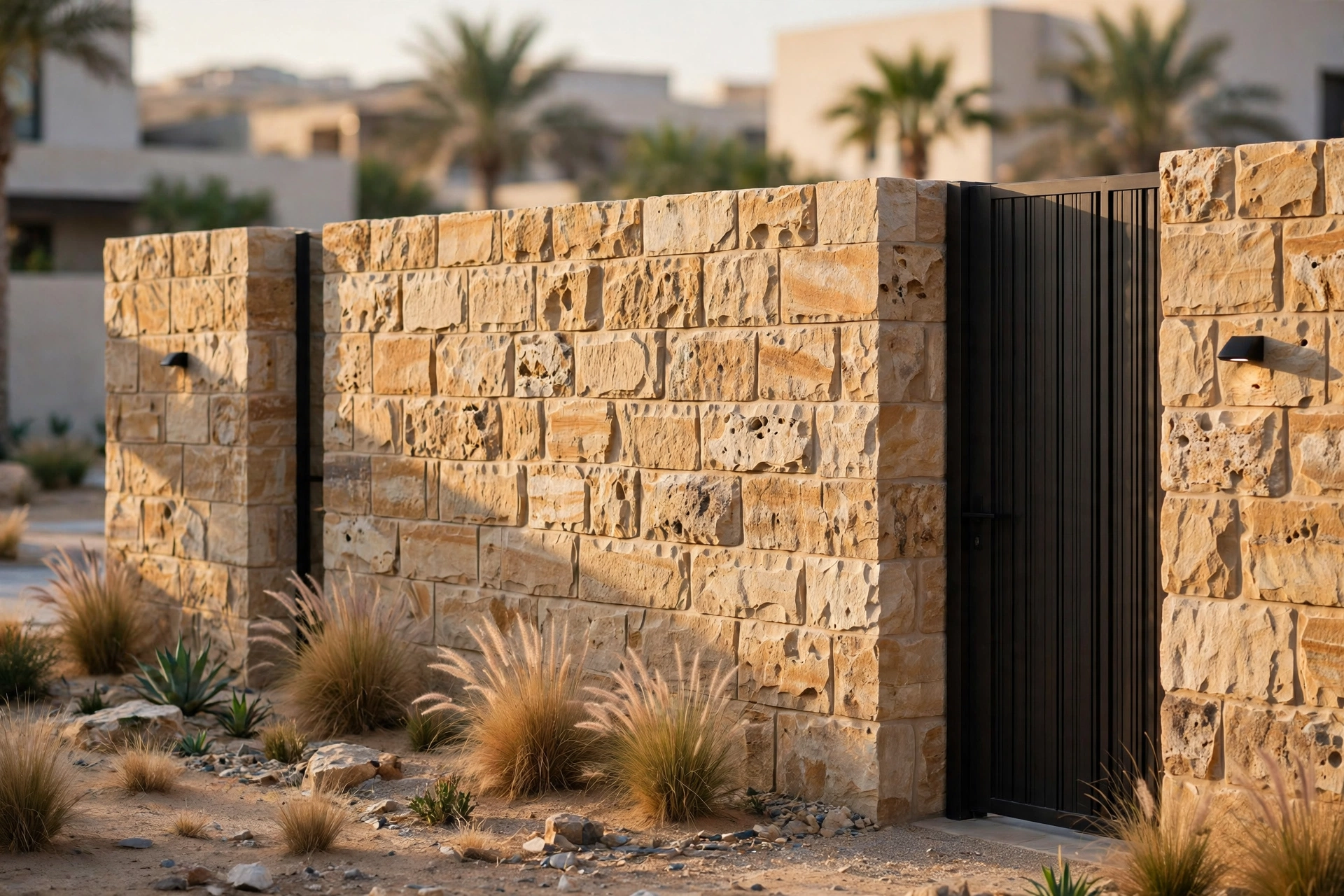
3. Boundary Wall Cladding
Boundary walls are the most-seen, least-loved walls on any property — usually plain painted block that stains and streaks. Stone or porcelain cladding transforms them into design features: sandstone warmth, slate texture, or sleek large-format porcelain. Add wall-washer lighting and a clad boundary wall becomes the villa's night-time signature, seen by everyone on the street.
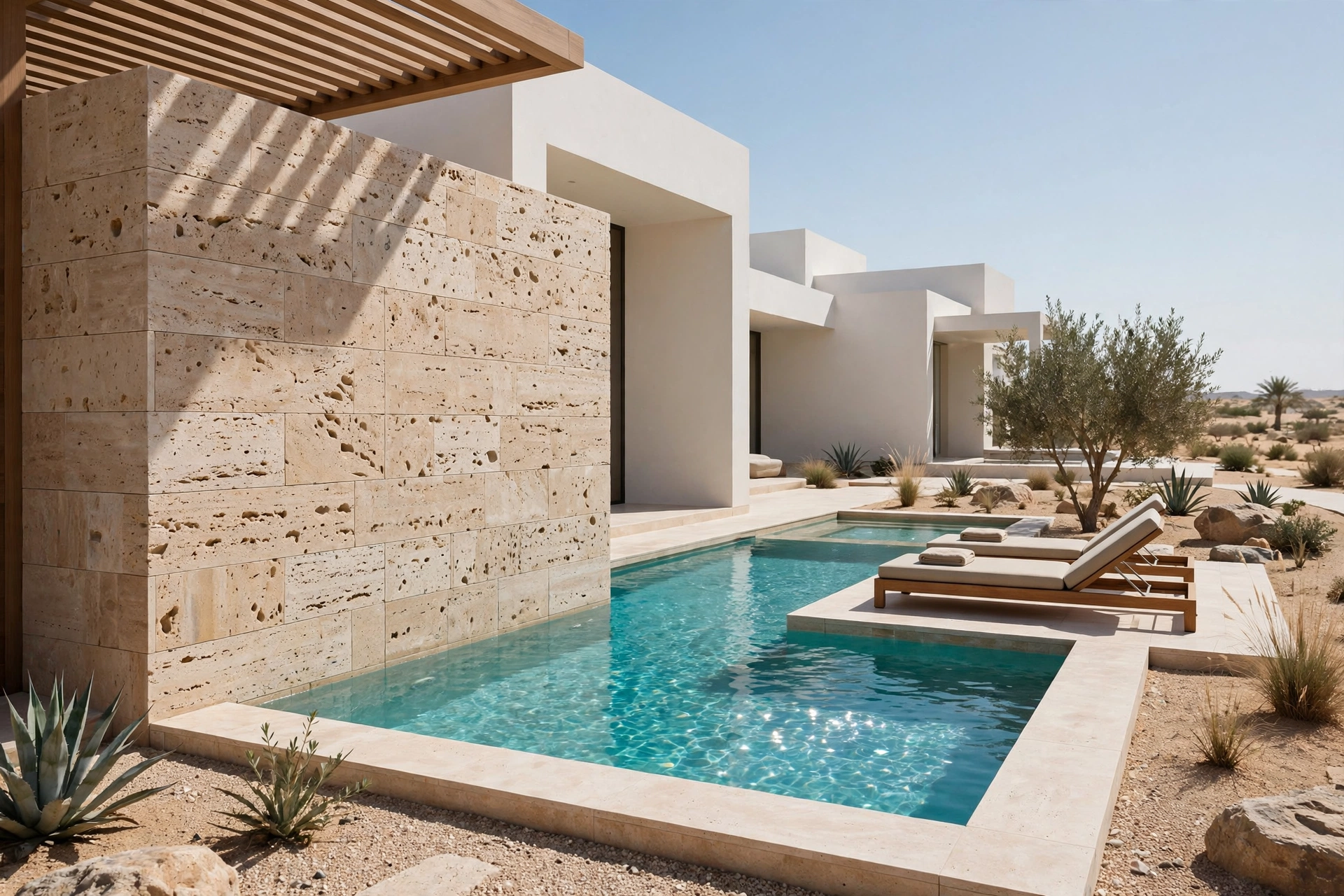
4. Poolside & Outdoor Walls
Pool areas punish walls — constant moisture, chemical splash, intense sun. Travertine and porcelain cladding handle it all: chlorine-resistant finishes and the resort aesthetic that makes a home pool feel like a hotel. We specify materials rated for wet environments and seal appropriately, so the walls around your pool look as good as the water.
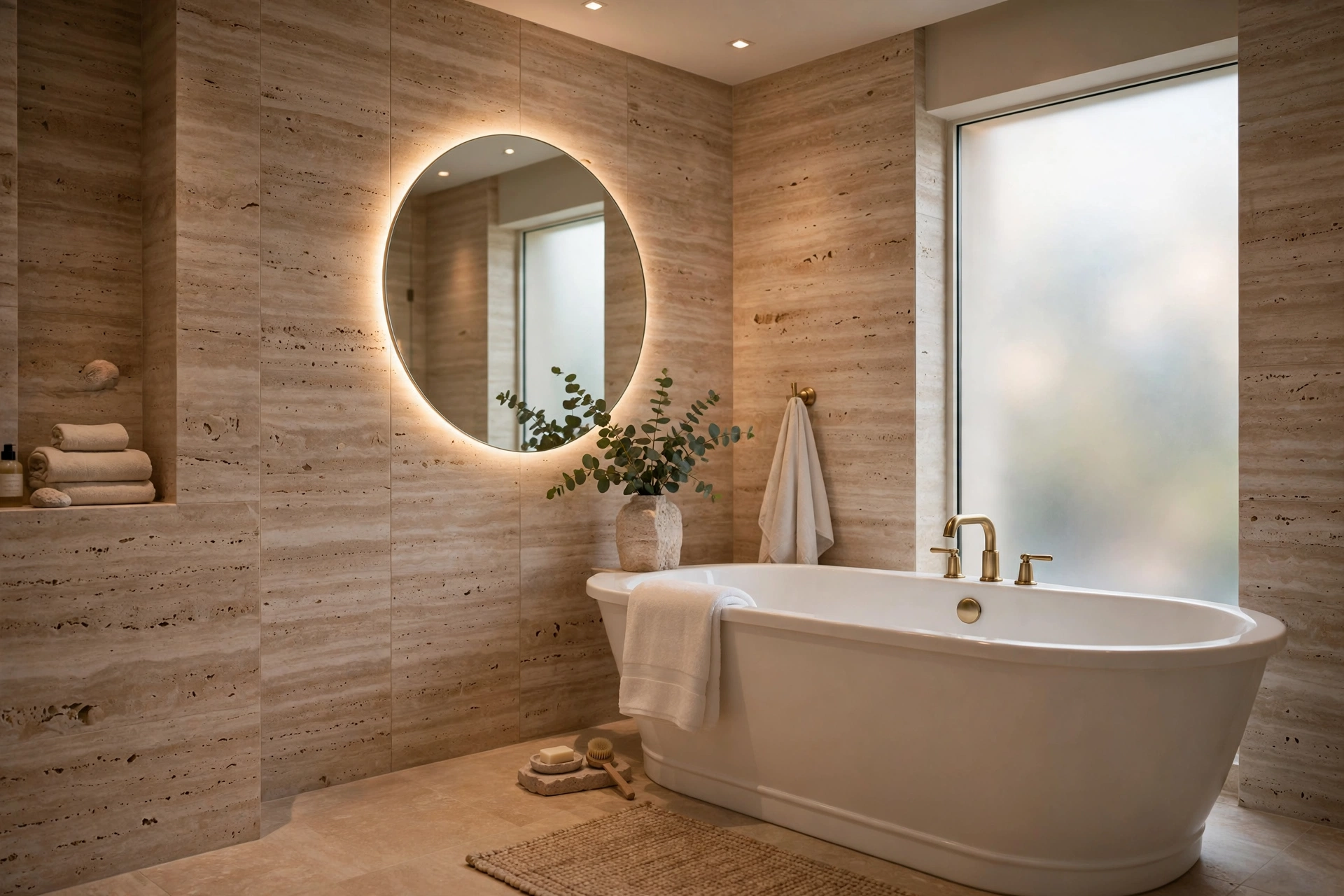
5. Bathroom & Wet-Area Cladding
Full-height porcelain cladding is the modern bathroom standard — seamless, grout-minimal, waterproof walls from floor to ceiling. Large-format marble-look porcelain delivers luxury without marble's maintenance. And the critical discipline: we tank (waterproof) behind every wet-area clad wall, because the cladding is only as good as what's beneath it. The visible tile is half the system; the waterproofing behind it is the other half.
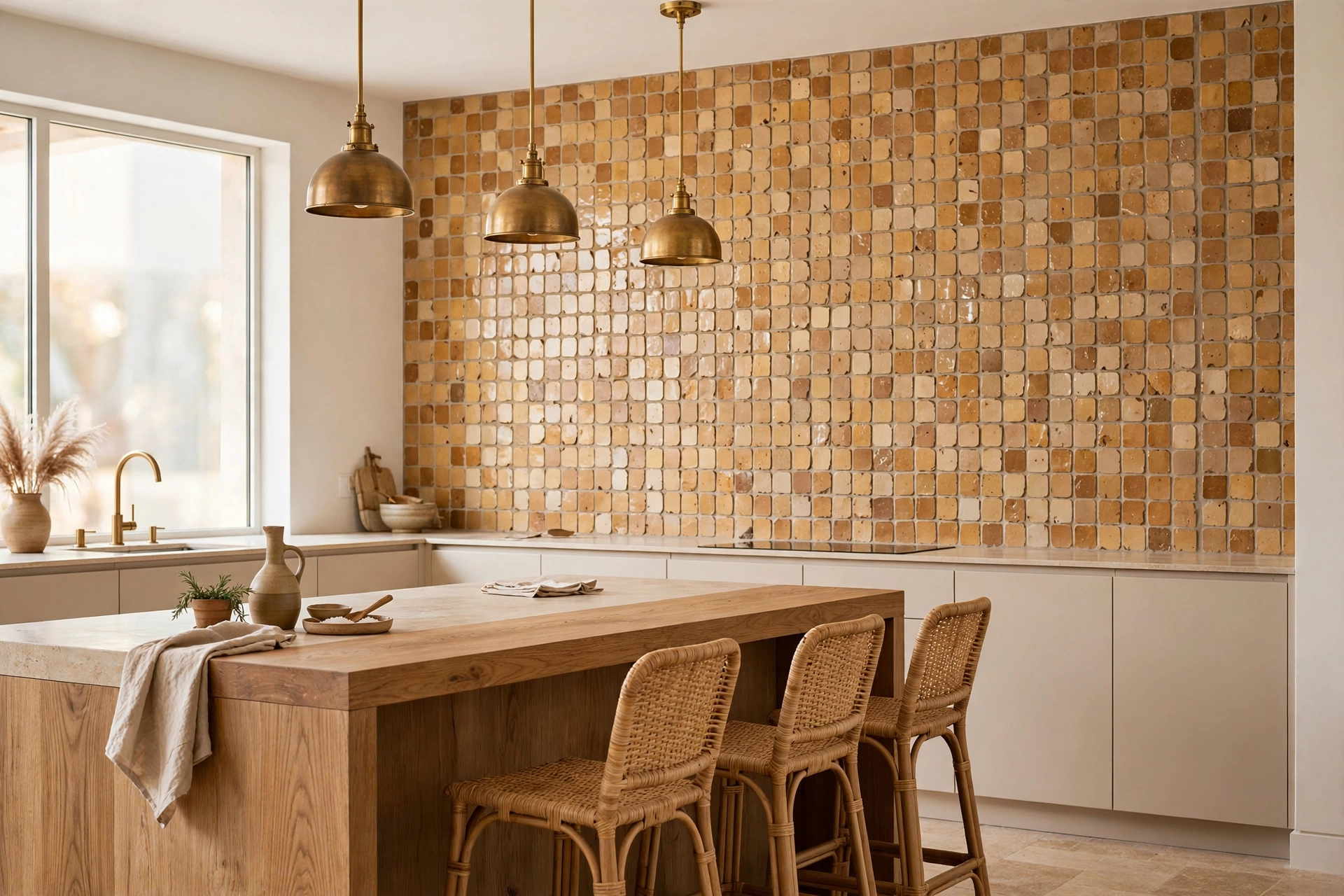
6. Kitchen Cladding
Full-height kitchen wall cladding — stone-look porcelain or textured tiles running to the ceiling — replaces the dated backsplash strip with a wall that's a design feature. Heat-resistant, wipe-clean, and dramatically more impactful than a 60cm tile band. A favourite in open-plan kitchens where the wall is always visible from the living area.
Beyond homes, we clad commercial spaces too: office facades and entrances, retail frontages, restaurant interiors and exteriors, hotel lobbies and pool areas, and healthcare facilities with hygienic HPL panel systems. Commercial work gets phased scheduling to minimise disruption, and materials are specified for traffic, cleaning regimes and maintenance budgets — not just opening-day photographs.
Wet-Area Cladding Done Properly
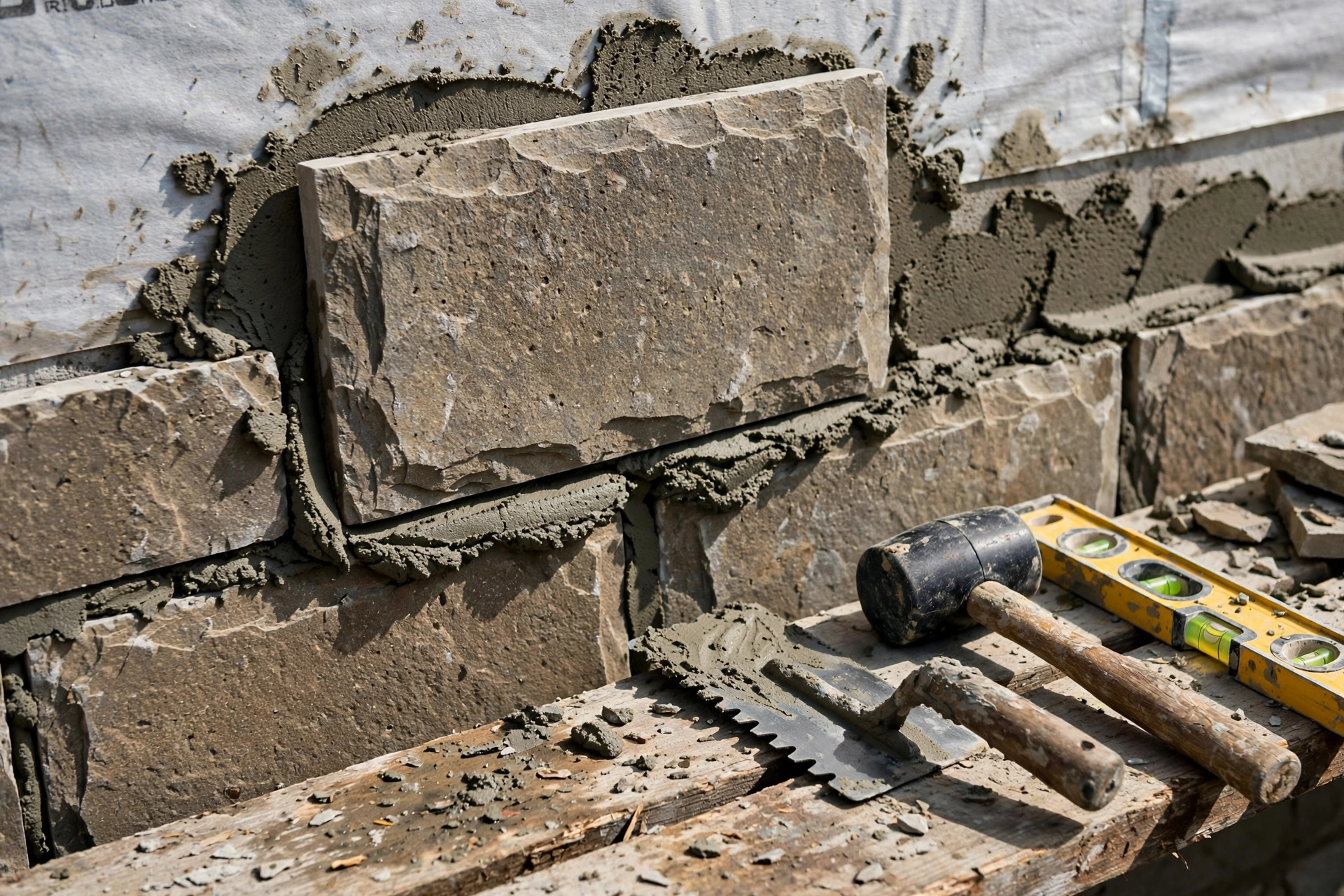
Wet-area cladding fails from behind, not from the front. This is the single most important thing to understand about bathroom and kitchen cladding: the visible tile is only half the system. Waterproof tanking membranes, correct falls, sealed penetrations and flexible grout decide whether the wall lasts for decades or leaks within a few years.
Our wet-area process runs in strict order: the substrate is assessed and repaired, a tanking membrane is applied (and flood-tested where appropriate), then large-format porcelain or stone is installed with waterproof adhesives and epoxy grout in the wettest zones. We never tile over unprepared or unwaterproofed walls — that shortcut is the most common cause of the bathroom failures we are called in to fix. A properly tanked and clad bathroom is effectively permanent; a pretty tile over a damp wall is a countdown.
The payoff is a wet room with minimal grout lines, no paint to peel, and surfaces that wipe clean. Large-format slabs — up to 120x280cm in porcelain — mean fewer joints where moisture and mould can take hold. It's the finish Dubai's luxury bathrooms and hotel spas are built on, and it works just as well in a compact apartment bathroom.
Cladding vs Panelling — What's the Difference?
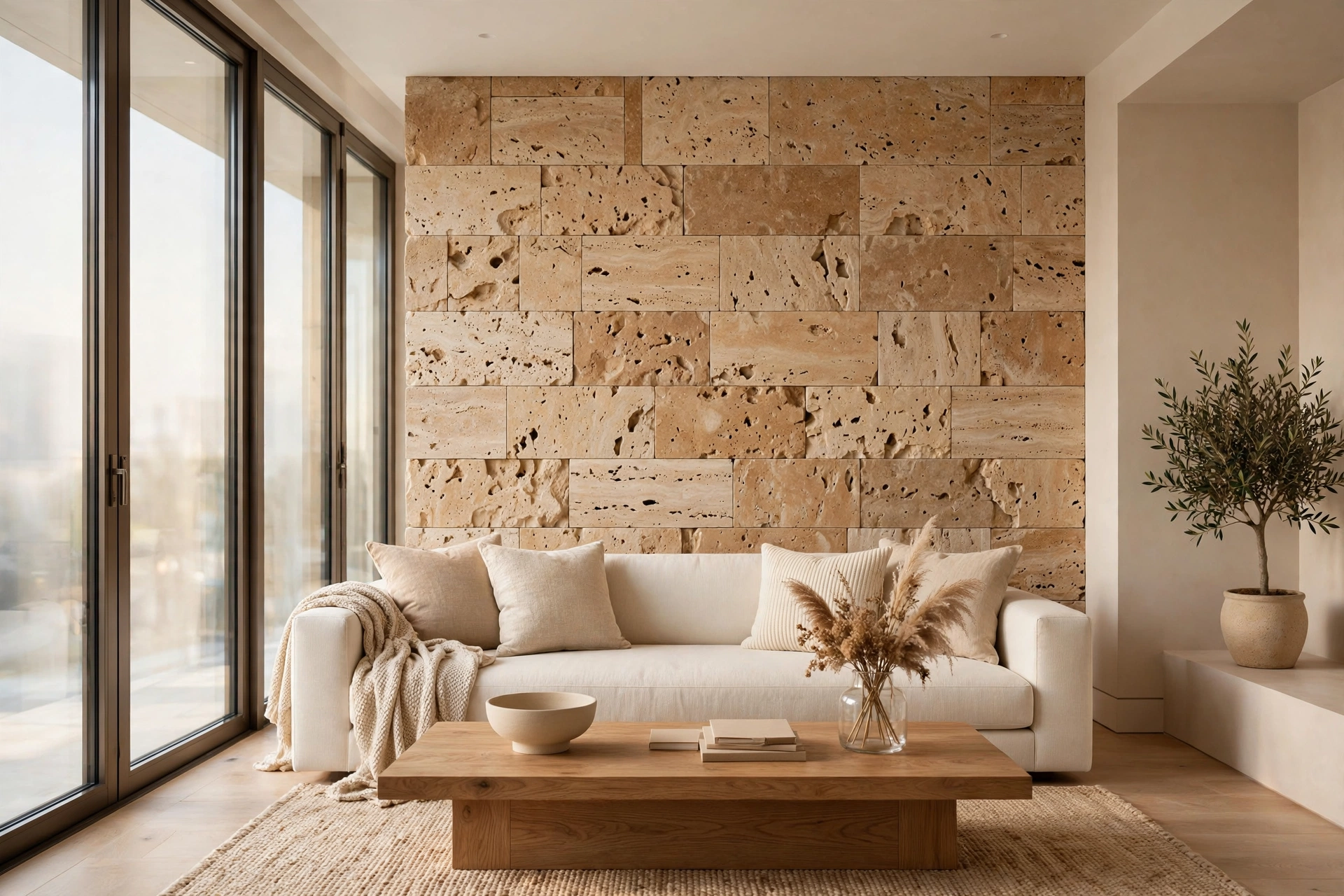
Clients often confuse the two, so here's the simple distinction: cladding protects — it's a weather-resistant skin of stone, porcelain or specialist panels, engineered for exteriors and wet areas. Panelling decorates — it's a crafted interior finish in timber, WPC or fabric, designed for living spaces. Cladding is specified for exposure; panelling is chosen for atmosphere.
Getting this wrong has real consequences. Timber panelling on a sun-blasted facade will fail; porcelain cladding in a cosy bedroom will feel cold. The rule of thumb: bathrooms, kitchens, facades, boundary walls and pool areas want cladding; bedrooms, living rooms and majlis spaces want panelling. We install both — see our wall panelling Dubai page for the decorative side — and during consultation we'll tell you plainly which your wall needs.
Interior Stone Cladding Features
Stone cladding isn't only exterior — book-matched marble and travertine feature walls bring facade-grade luxury indoors. A single book-matched marble wall in a living room or entrance hall is one of the most prestigious interior statements available: the veining mirrors across the joint like an opened book. We precision-cut and sequence every panel so the match is perfect, then light it to reveal the stone's full drama. Interior stone cladding also suits fireplace surrounds, lift lobbies and spa bathrooms — anywhere permanence and luxury matter more than anywhere else in the home.
For a more sculptural take on the feature wall, explore our feature wall design Dubai and 3D wall panels Dubai pages — stone cladding sits beautifully alongside panelled and textured feature treatments.
Does Cladding Add Property Value?
Among exterior upgrades, cladding has one of the strongest value cases, for three reasons. First, curb appeal: a stone-clad facade photographs dramatically better than painted render, and first impressions drive viewings. Second, the maintenance story: buyers understand that clad walls need no repainting — a tangible, calculable future saving. Third, perceived quality: stone reads as premium construction, lifting the whole property's positioning in the market.
For landlords, clad boundary walls and entrances justify stronger rents through sheer presence. For sellers, the facade is the listing photograph. For long-term owners, the maths is simplest: one cladding installation versus repainting every few years for decades. We'll give you honest guidance on where cladding pays and where it doesn't — a short-hold rental flip rarely justifies it; a forever home almost always does, many times over.
Wall Cladding Trends for 2026
Large Formats
Bigger panels, fewer joints — 120x280cm porcelain slabs replacing small tiles on facades, bathrooms and feature walls alike.
Fluted Stone
Three-dimensional carved stone textures — fluted and ribbed profiles that catch light and shadow on facades and feature walls.
Mixed Facade Materials
Stone meeting timber-look porcelain meeting render — layered exteriors with two or three materials composed rather than a single finish.
Dark Exteriors
Charcoal and bronze cladding for contemporary villa statements — dramatic, modern, and striking against Dubai's bright light.
Seamless Wet Areas
Full-height large-format porcelain with minimal grout lines — the hotel-spa bathroom look, now standard in premium Dubai homes.
Natural Stone Revival
Travertine and sandstone back in force — buyers rediscovering that natural variation photographs as luxury in a way uniform finishes can't.
Our Wall Cladding Installation Process
Cladding is unforgiving — fixing failures are structural, water ingress is destructive, and a bad stone job is visible from the street for decades. Every project follows the same disciplined steps, so nothing is skipped:
Site Assessment
Wall condition, structure, moisture and sun exposure assessed; material samples shown against your actual walls.
Design & Specification
Material, fixing system and layout specified for your exposure — mechanical fixing where weight demands it.
Fixed Quotation
Itemised written quote covering materials, fixing systems, scaffolding, sealing and labour. No vague line items.
Preparation
Substrate repaired and levelled; tanking applied where needed; setting out marked before a single panel goes up.
Installation
Cladding fixed with the specified system; expansion joints, corners and reveals detailed as the work progresses.
Seal & Handover
Sealing, final clean, written maintenance guidance and a full walkthrough of the finished walls.
What Affects the Cost of Wall Cladding
We don't publish fixed prices because cladding cost genuinely depends on the project — and any contractor quoting a single figure without seeing your walls is guessing. These are the factors that move the number:
- Material choice: porcelain is the most accessible; limestone and travertine sit in the middle; marble and granite are the premium tier.
- Area and height: total square meterage dominates the cost, and high walls need scaffolding, access and site management.
- Fixing system: adhesive-fixed porcelain versus mechanically-fixed ventilated stone systems are very different installations.
- Substrate condition: walls needing repair, levelling or waterproof tanking before cladding add necessary preparation work.
- Detailing complexity: corners, window reveals, integrated lighting, book-matching and sealing all add skilled labour.
- Location logistics: villa communities, high-rise apartments and commercial sites each have their own access and working-hour constraints.
The fastest route to a real number: send photos and rough dimensions on WhatsApp for an initial estimate, then a free site assessment fixes your exact quote — with the complete system specified, including materials, fixing, scaffolding, sealing and finishing. We install across Dubai — villa facades and boundary walls in Palm Jumeirah, Emirates Hills, Arabian Ranches, Mirdif and Al Barsha; bathrooms and kitchens in apartments across Marina, Downtown, Business Bay, JLT and JVC; commercial facades and interiors anywhere in the emirate.
Cladding Maintenance Guide
One of cladding's great advantages is low maintenance — but low isn't zero. Here's what each material actually needs:
- Porcelain: wash with water and mild detergent. Stain-proof and fade-proof — the closest thing to zero-maintenance cladding.
- Sealed stone: reseal porous stones (travertine, limestone, sandstone) every few years depending on exposure; clean with pH-neutral stone cleaner, never acids.
- Granite and marble: inspect the sealant annually and clean spills promptly on marble to avoid staining.
- Wood cladding: wash down dust buildup and refresh the UV-protective oil or stain when water stops beading on the surface.
- Joints and sealant lines: check expansion joints yearly — the number one preventable failure point on any clad wall.
- Drainage: keep weep holes and drainage paths clear on ventilated facade systems so walls can breathe.
We leave every client with written maintenance guidance specific to their materials — and we're a message away on WhatsApp if anything ever looks wrong.
Cladding Mistakes to Avoid
Most cladding failures we are called to repair trace back to one of these six shortcuts. Knowing them protects your investment:
Adhesive-Only Exterior Fixing
Heavy stone on facades needs mechanical fixing. Adhesive alone fails over time — dangerously. This is the failure we see most, and it's entirely avoidable.
No Expansion Provision
Dubai's heat cycles expand cladding every day. Rigid systems installed without expansion joints crack — the joints are engineering, not decoration.
Skipping Tanking in Wet Areas
The tile is not the waterproofing. Cladding a bathroom without tanking behind it is building a leak with a beautiful face.
Wrong Stone for the Exposure
Soft, porous stone on a sandstorm-facing facade erodes. Specify hardness and density for the exposure, not just the showroom sample.
Sealing Dense Porcelain
Unnecessary — and it can cause hazing on the surface. Seal porous natural stone; leave dense porcelain alone.
Choosing the Cheapest Quote
Cladding failures are structural and expensive to fix. The fixing system and preparation matter more than the stone price — compare specifications, not just totals.
Wall Cladding Dubai — FAQs
Walls That Outlast Trends
Send us photos of your walls today — get a free site assessment, climate-correct material advice, proper fixing-system specification, and cladding installed to last for decades, not years. Available 7:00 AM–12:00 midnight, every day.
Get My Free Quote